TL;DR
Salespeople don’t resist practice because they are lazy or unmotivated. They resist it because most practice feels like a public test. Behavioral science shows that humans avoid situations where they might be judged, especially by people whose opinions matter to their status and livelihood. Psychological safety is what changes that. When practice becomes private, repeatable, and low-risk, people lean into it instead of away from it. AI role plays create that kind of judgment-free space at scale.
Platforms like GTM Buddy turn this into a system, not a one-off workshop. Reps can practice tough conversations on their own, get feedback without feeling exposed, and walk into real deals with more confidence. The net effect is better execution in live opportunities, more predictable revenue, and teams that feel safer to learn, not just perform.
Sales performance improves when practice feels safe. AI role plays remove the social risk that blocks repetition, experimentation, and skill development, making practice psychologically easier and operationally scalable.
When practice feels like a test, people stop practicing
If you lead a sales team today, you live in constant trade-offs. You need faster ramp, better win rates, sharper discovery, tighter multi-threading. At the same time, you know your reps are already stretched by quota pressure, internal meetings, and admin work. When you tell them, “We’re going to do more role plays,” you can almost feel the room stiffen.
That reaction is not resistance to growth. It’s self-protection.
Studies on psychological safety show that people learn fastest when they feel free to speak up, ask for help, and admit mistakes without fear of embarrassment or punishment. In a 2020 field study of 104 sales and service teams, psychological safety did not directly raise performance, but it fueled learning behaviors and team confidence, which in turn drove effectiveness, as described in this paper by the National Library of Medicine.
When people felt safe, they experimented more, shared information more, and trusted the team’s ability to solve hard problems.
Traditional coaching environments often reverse this. A manager plays the buyer. Peers watch. The rep is told, “Don’t worry, this is a safe space,” but everything about the setting screams evaluation. Who looks smart. Who sounds polished. Who fumbles.
Under those conditions, most reps aim for survival, not growth. They stick to the safest answer, avoid the risky objection, and mentally count down until it’s over. From the outside, it looks like practice. Inside, it feels like a test.
Fear of being judged: the invisible drag on skill development
If you sit with reps one-on-one and ask why they dislike role plays, the answers vary. “It’s awkward.” “It feels fake.” “We never role play the way customers actually talk.” Beneath these surface complaints sits a deeper driver: fear of negative evaluation.
Psychologists use this term to describe a specific kind of anxiety. It is the dread of being judged, especially in public, and it shows up strongly in learning environments. In a study of community college science courses, students reported that their anxiety spiked in activities where they might look foolish in front of peers or instructors. They were not afraid of the material. They were afraid of other people’s reactions, as explored in this Life Sciences Education journal.
Sales is a similar pressure cooker. Reps know they are being watched by managers, leaders, and peers. Every misstep feels like it could signal something bigger: “Maybe I’m not cut out for this,” “Maybe I’m slipping,” or “Maybe I shouldn’t be in this seat.” That is especially true for:
- New hires, who are still building basic competence and don’t yet have a track record to fall back on.
- Mid-level reps, who worry that exposing gaps will confirm they have stalled out.
- Senior AEs, whose identity is wrapped up in being the person others come to for answers.
Recent work on fear of evaluation by the National Library of Medicine goes even further. It shows that people can fear both negative and positive evaluation. Being praised can raise expectations and invite more scrutiny next time. For a top seller, that can mean, “If I do badly in this role play, they’ll wonder if my success was luck.”
When you look at role plays through this lens, avoidance is not surprising. It is rational.
Why the classic coaching model hits a ceiling
Most enablement programs have three familiar moves: workshops, live call reviews, and role plays. Each matters. But all three share a hidden flaw. They put reps under social observation while they are still trying to figure things out.
Team research on psychological safety is clear about what happens in those moments. When people feel watched and judged, they shift from learning mode to impression management. They manage how they look instead of improving what they do.
In sales, that looks like:
- Reps rehearsing a “perfect” answer instead of trying a new question framework.
- Sellers avoid messy real-world objections because they feel risky in front of peers.
- High performers opt out of practice entirely because they don’t want to be seen struggling.
A Forbes overview on psychological safety in teams notes that when people fear blame or shame, they become quieter, play smaller, and avoid drawing attention, even if it means missing opportunities to improve performance. The result in sales is subtle but costly: the reps who most need practice get the least of it, and the practice they do get is watered down.
You can add more coaching hours, but as long as the emotional risk stays high, the learning curve will stay flat.
AI role plays as a different kind of room
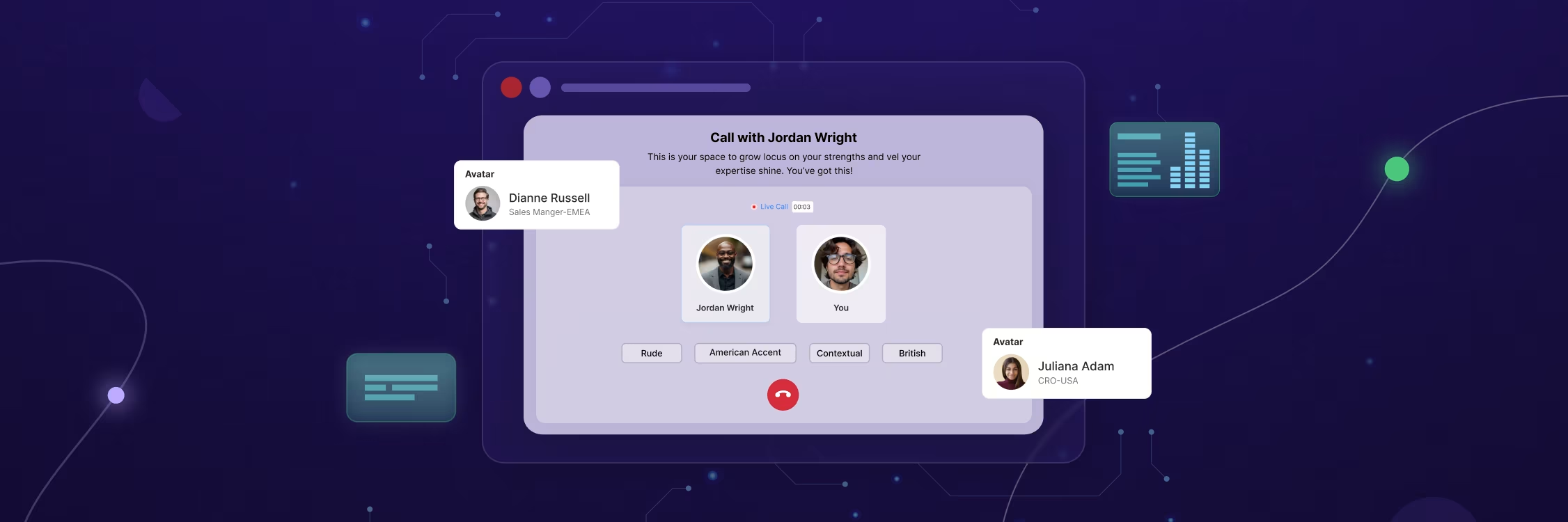
AI role plays flip the script by changing one key variable: the audience. The content of practice still matters - good prompts, realistic scenarios, sharp feedback. But the biggest psychological shift comes from the fact that no human is watching.
Alone with an AI buyer, a rep can:
- Stop and restart mid-conversation.
- Try three different ways of asking the same question.
- Test a new story they are not ready to share in front of peers.
- Walk into a worst-case objection and intentionally see what breaks.
Because there is no social cost, their goals change. They are no longer trying to look good. They are trying to get better.
This maps closely to what a team of researchers call learning behavior: the small, repeated actions of seeking feedback, experimenting, and reflecting. In the sales-team study from South Korea, psychological safety boosted these learning behaviors, which then strengthened team efficacy - the shared belief that “we can do this” - and that belief was a major driver of performance.
GTM Buddy builds that safety into the system. GTM Buddy’s AI Role plays adapt to the rep’s level, product line, and target persona. A new SDR might work through basic cold-openings, while a senior AE practices late-stage pricing pushback with a simulated CFO. Both get space to fail privately and adjust quickly.
Tying practice back to the GTM scoreboard
For enablement and revenue leaders, psychological safety is not just a cultural topic. It has direct links to the numbers you are held accountable for.
Faster, more confident ramp
Onboarding is where fear of evaluation bites hardest. New hires are trying to prove they belong while learning products, playbooks, and tools. If their only practice is public, they will speak less and memorize more. That slows the ramp.
In a judgment-free simulation environment, new reps can run dozens of conversations before their first live call. They can repeat the same discovery scenario until it feels natural. They can try and discard bad habits without anyone seeing. By the time they talk to real buyers, they have already experienced the rough edges in private.
The outcome is not just faster certification. It is a deeper readiness. New hires are less likely to freeze on a call because they have already felt uncomfortable in a low-risk setting. To learn more about how to improve sales ramp time by half, click here.
More consistent execution across the team
Most GTM leaders have a version of the same frustration: you invest in messaging work, run a big enablement push, and then hear wildly different stories in the field. Some reps nail the new narrative. Some partially adopt it. Others quietly keep doing what worked two years ago.
From a behavioral perspective, this is not about attitude. It is about safety. Changing the way you talk in front of a customer is hard. Changing the way you talk in front of your peers can feel even harder.
AI role plays give reps a bridge. They can practice the new story, adjust it to their own style, and see it land in different simulated situations. Because the practice is private, they are more willing to stick with it long enough for it to feel natural.
Over time, that produces more consistent execution across the team, which shows up in cleaner deals, clearer value articulation, and fewer surprises in late stages.
Stronger performance under pressure
Pressure reveals the quality of practice. In late-stage negotiations, executive meetings, or renewal saves, reps do not have time to think through a script. They fall back on whatever has been repeated most often.
If most repetition happens in judgment-heavy environments, reps default to the safest, most generic talk tracks. They avoid uncomfortable questions, soften their point of view, and let momentum decide the outcome.
When they have rehearsed those same moments in AI role plays, the picture is different. They have already practiced saying, “It sounds like price is important, but not the only driver. Can we unpack what a successful outcome looks like for you?”
They have already heard a simulated CFO push back hard. In the live moment, their nervous system has a reference point. That familiarity reduces cognitive load and improves performance.
GTM Buddy’s insights reinforce this by surfacing patterns between how reps behave in role plays and what happens in real deals. Over time, you can see which behaviors in practice correlate with higher close rates or stronger expansion outcomes.
Real-world examples of judgment-free practice in action
To make this more concrete, consider four personas you likely have on your team and how a judgment-free AI environment shifts their daily reality.
The new SDR trying to find their voice
Goal: book more qualified meetings without sounding scripted.
In a typical onboarding, this SDR gets a few days of product training, a call script, and maybe one or two live role plays with a manager. They know they sound stiff, but they also know everyone is listening. So they cling to the script.
With AI role plays, they can spend their first week running dozens of cold-openings and objection-handling conversations. They try different hooks for the same persona. They practice follow-up questions when a prospect gives a vague answer. Each time, they get instant, non-judgmental feedback.
The business impact is simple: their first month on the phones is not their first month learning to talk. It is their first month applying what they have already rehearsed.
The AE navigating a new ICP
Market shifts often force AEs into new industries or buyer groups. Even strong reps feel uncertain when they walk into their first call with a CISO or a VP of Finance - buyers whose language, risks, and decision criteria are unfamiliar.
In psychologically unsafe environments, that uncertainty shows up as avoidance or oversimplified conversations. Reps stick to surface-level discovery, lean too heavily on features, or delay engaging those accounts altogether.
With AI role play, an AE can walk through ten discovery calls with a new ICP before ever touching a live account. They experience how that persona pushes back, what risk sounds like in that world, and how their value proposition lands when framed in the buyer’s reality.
For the business, this shortens the time it takes for new segments to become productive and reduces the risk of burning critical early conversations that shape long-term deal momentum.
The senior AE up-leveling their narrative
Senior AEs are often the first to carry new product narratives into the field. New launches, repositioning, or pricing changes demand a different level of storytelling - one that resonates with executives and holds up under scrutiny.
These reps don’t need basic practice. They want space to refine how they talk about value, pressure-test new negotiation angles, and translate product changes into credible executive conversations.
AI role play gives them a private environment to do exactly that. They can rehearse new narratives, experiment with pricing frames, and adapt their story for different executive personas without the noise or performative pressure of group sessions.
For the business, this keeps top performers sharp and evolving as the product evolves. It also surfaces high-quality patterns - language, objections, and positioning - that can be reused to design stronger simulations and guidance for the rest of the team, without asking senior AEs to play the role of examples in public.
The CS manager preparing the team for tough renewals
Goal: protect NRR when budgets are under review.
Customer teams often face emotionally charged conversations: budget cuts, leadership changes, dissatisfaction with value. Most CS reps experience these only a few times a quarter, so every encounter feels high-stakes.
With AI role plays, a CS team can rehearse many variations of the same scenario in a quarter. A champion has left. The new CFO is skeptical. Usage is flat. The rep learns to stay calm, ask grounding questions, and reframe the conversation around outcomes.
The payoff shows up in renewal rates and in softer signals: fewer escalations, more proactive outreach, and a team that feels equipped rather than exposed.
Confidence is not a pep talk. It is a pattern.
It is tempting to treat confidence as a mindset problem. If reps only “believed in themselves” more, they would perform better. Behavioral science paints a different picture. Confidence is mostly a memory of successful repetitions.
People feel confident when they have seen themselves solve similar problems before. Not once or twice. Many times. In contexts where failure was allowed and feedback was clear.
Traditional practice offers too few repetitions and too much social risk. AI role plays offer the opposite: many repetitions, minimal social risk, and immediate feedback. Over weeks and months, this changes what reps remember about themselves.
They remember the time they turned a tough budget objection around in an AI Role play. They remember the fifth attempt at a new discovery flow that finally felt natural. In live calls, those memories sit just below the surface. That is what confidence really is.
GTM Buddy amplifies this by turning those patterns into visible progress. Reps can see how their role play scores based on rubrics, behaviors, or completion patterns improve over time. Managers can see who is putting in the reps, where they are stuck, and where targeted human coaching will have the biggest impact.
A more humane GTM system
If you strip away the buzzwords, psychological safety is about one thing: making it safe to try. For sales teams, that is not just a cultural virtue. It is a competitive edge.
Research on corporate innovation and creativity shows that teams in psychologically safe environments propose more ideas, share more information, and adapt faster when the environment changes. In sales, the same dynamic means:
- Reps surface real objections they are hearing instead of hiding them.
- Teams share what actually works in the field, not just what sounds neat in a deck.
- Leaders hear the truth sooner and can adjust GTM strategy before issues snowball.
AI role plays are not a magic trick. They are an infrastructure choice. They turn the idea of a “safe space” from something leaders say in meetings into something reps experience every day in their workflow.
The result is a GTM system that is more human, not less. One where people have more room to be honest about what they don’t know and more support to get better.
Bringing it all together
Psychological safety is not a “nice to have” in sales. It is the condition that decides whether your team experiments, learns, and adapts fast enough to keep up with your buyers. When practice feels like a test, reps play small. When practice feels private, repeatable, and forgiving, they grow.
AI role plays are one of the most practical ways to build that kind of environment every day. They turn what used to be rare, high-pressure coaching moments into frequent, low-risk learning reps. Over time, that shows up in shorter ramp, stronger conversations, more consistent execution, and a team that is less afraid of hard problems.
GTM Buddy sits in the middle of that shift. It connects realistic role plays to your actual GTM reality - your products, your personas, your objections, your deals - so practice is not abstract. It is a direct rehearsal for the conversations that move your pipeline.
Where to start
If you are a sales, enablement, or revenue leader, you don’t need to redesign everything at once. Start small and specific.
Pick one conversation that matters this quarter: first discovery in a new segment, late-stage pricing reviews, or renewal saves. Build or enable a focused set of AI role plays around that moment. Give reps time to struggle there in private first, then bring a slice of it into your team coaching.
Watch what happens to their willingness to try, to ask, and to share. That change in behavior is psychological safety becoming real.
If you want to see what this looks like in a system built for GTM teams, explore how GTM Buddy can plug role plays into your existing workflows. Used well, it becomes less “another tool” and more the quiet practice room behind every confident conversation.
FAQs
1. Isn’t this just another coaching tool?
No. Traditional coaching tools assume reps will keep showing up to public practice. AI role plays change the emotional equation by making most practice private. Human coaching then becomes more targeted and more valuable because reps have already done the basic reps on their own.
2. Will reps actually use AI role plays without a manager watching?
When practice is safe, relevant, and available on demand, usage tends to rise on its own. Reps quickly feel the benefit of walking into calls better prepared. Teams using systems like GTM Buddy often find that their highest performers become the heaviest role play users because it lets them stay ahead without putting their reputation at risk.
3. Does psychological safety mean we stop holding people accountable?
No. It means you separate learning environments from evaluation environments. You still measure outcomes on real deals. You still give clear expectations. You simply make sure that the place where reps learn is not the same place where they are judged.
4. How do we know if AI role plays are working?
Look for changes in both behavior and numbers. Are reps practicing more often? Are they more willing to try new messaging in live calls? Do you hear more consistent stories across the team? Over time, you should also see leading indicators move - better early-stage conversion, fewer stalled deals, and stronger renewal outcomes.
5. What about peer role plays? Should we stop doing them?
Peer practice is still valuable, especially for building trust and team alignment. The difference is that peer sessions work better when reps have already done private repetitions first. AI role plays lift the baseline so group time can focus on nuance, not basic mechanics.
6. How does this help managers specifically?
Managers get out of the business of recreating the same scenarios over and over. Instead, they can see how their reps are practicing, review a sample of simulation outcomes, and spend live coaching time on higher-order topics: deal strategy, account planning, and personal development.
7. Can AI really feel realistic enough for senior conversations?
The quality depends on how the system is built. When role plays are grounded in your actual call patterns, objections, and buyer language - as with GTM Buddy - they feel much closer to reality than generic scripts. Senior reps often report that role plays help them anticipate patterns they might miss in their own pipeline.
8. How do we roll this out without creating more tool fatigue?
Anchor AI role plays to specific business moments: onboarding milestones, new messaging launches, renewal season, or entry into a new segment. Integrate them into existing workflows rather than launching them as “one more platform.” Make the benefit clear: this is their private practice room, not another reporting system.
9. Where does this show up on the revenue dashboard?
Over time, you should see a tighter link between enablement programs and pipeline outcomes. Faster ramp translates into earlier quota attainment. Better consistency in messaging translates into more predictable win rates. Stronger renewal conversations show up in NRR. Psychological safety becomes visible not only in survey scores but in the shape of your funnel.
10. What is the first move if we want a more judgment-free enablement culture?
Start by redesigning one practice moment. Take a critical conversation type - first discovery, proposal reviews, renewals- and move the bulk of practice into AI role plays. Give reps time to struggle there first. Then bring a smaller slice of that practice back into group settings. Over time, you will see resistance drop and curiosity rise.


.png)