

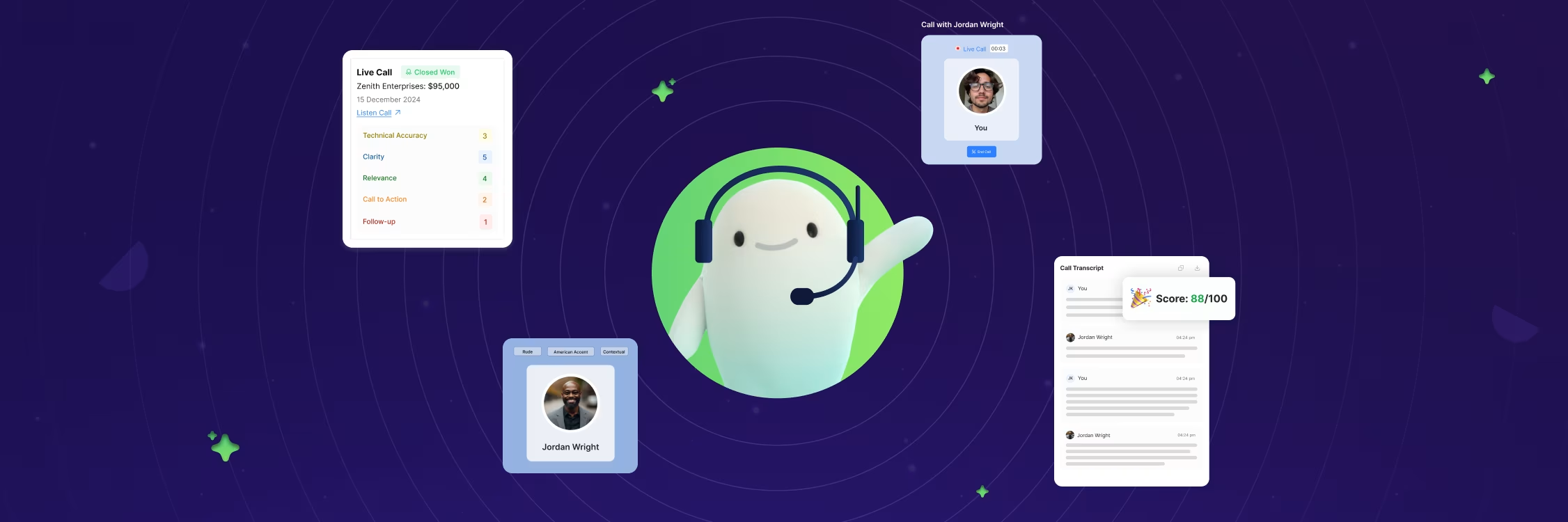
AI Role-Play is only valuable if it turns practice into performance. Most platforms sound alike, but only a few deliver the features that actually move ramp time, win rates, and renewals: realistic buyer simulations, scalable judgment-free practice, adaptive learning and feedback, data-driven coaching, and seamless LMS/CMS integration. Miss one and the tool demos well but stalls in the field.
The five features below are not independent product checkboxes. Together they define what Revenue Activation Engine-grade AI Role-Play looks like. Each one closes a specific gap that stops practice from translating into deal performance, and a platform missing any of the five is not just feature-short, it is structurally limited at converting training time into revenue capacity. That is the difference between AI Role-Play as a feature and AI Role-Play inside a Revenue Activation system.
If you are evaluating AI Role-Play platforms right now, you have probably noticed what most sales and enablement leaders do: every vendor promises smarter practice, faster ramp, and better coaching, and the moment you look closely, the differences blur. It helps to be precise about what you are buying. AI Role-Play is the use of AI to simulate sales conversations, discovery, objection handling, demos, and negotiations, so reps can practice against realistic conditions before they face a real prospect. In a Revenue Activation Engine, it is the practice layer that converts training time into deal-ready capacity. The real question is not who promises that. It is which features actually deliver it, and which are demo polish. Use the five below as a diagnostic, and ask any vendor to prove each one rather than claim it.
Feature 1: Realistic buyer simulations
Practice only builds confidence if it feels like the real thing. Too often, role-plays are generic, scripted, and disconnected from your actual ICPs and deal dynamics, which produces a rep who is technically trained but unprepared for the messy objections and competitive realities of a live conversation. A rehearsal of a conversation that never happens is worse than no rehearsal, because it builds false confidence.
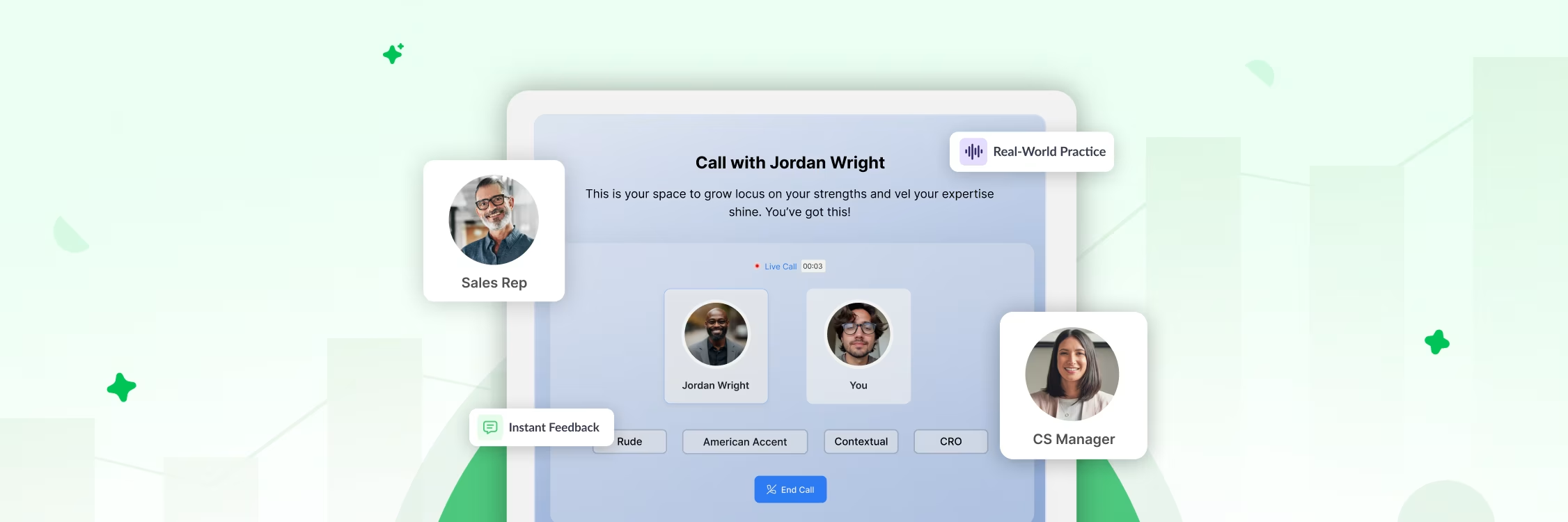
The platforms worth buying ground every scenario in your content, your personas, and your competitive landscape. GTM Buddy's AI Role Play uses your content ecosystem to generate scenarios that feel indistinguishable from live calls, and it does not just play a role, it mirrors real behavior: a CFO who fixates on ROI, a CTO drilling into integrations, a CEO who interrupts to test composure. Under the hood that breadth is concrete, more than 200 scenarios spanning sales stages from discovery to renewal and deal rescue, stakeholders from procurement to legal to champion, channels from live call to email to boardroom, and buyer moods from skeptical to openly hostile. Picture an SDR pitching a skeptical operations manager who keeps asking how this saves them time, until the rep learns to frame value in operational terms. That is deal-stage preparation, not abstract practice.
Revenue Activation Engine requirement: practice tied to real deal context, not generic scripts.
Feature 2: Scalable, judgment-free practice
The biggest bottleneck in traditional role-play is manager time. Leaders cannot run mock calls for every new hire and every tenured rep, and reps should not have to fail in front of their peers, so practice gets rationed and the reps who most need it get the least. AI Role-Play breaks that constraint by giving reps unlimited, on-demand access. They can practice whenever they need to, fail privately, and repeat a scenario until they have it, with low-latency simulations that launch instantly, even on mobile, so downtime turns into skill-building time.
As Ron Baden, Head of Sales at GTM Buddy puts it, AI Role-Play is really about how you train and prep reps, the simulations mimic objections and behaviors so closely that the live interaction already feels familiar. New hires ramp faster, tenured reps sharpen before high-stakes calls, and managers get back the hours they used to lose to repetitive drills.
Revenue Activation Engine requirement: practice that actually gets adopted, which means private and on-demand.
Feature 3: Adaptive learning and feedback
A static script or a checklist does not build readiness. Real learning happens when feedback is immediate, specific, and adaptive, reacting to what the rep actually says rather than grading against a fixed key. The platforms that matter go well past pass or fail. They adjust in real time, shifting the persona, the tone, or the objection based on the rep's response, then return instant scoring tied to rubrics that match your sales process.
GTM Buddy's adaptive engine watches tone, pacing, content accuracy, and objection handling live, and escalates difficulty to mimic a real buyer's unpredictability. Its analytics break performance into clarity, relevance, technical accuracy, and call-to-action effectiveness, so feedback is targeted rather than a vague good job. Take a CSM practicing a renewal: it opens polite, and when the answers go generic the persona escalates, saying they are not sure it is worth the spend anymore. If the rep keeps struggling, the feedback flags exactly where they failed to tie value to ROI, so by session end they can see the specific steps to fix it, right then, instead of waiting for a sporadic manager review.
Revenue Activation Engine requirement: the right correction in the right moment, not a static rubric.
Feature 4: Data-driven coaching and analytics
Managers need more than intuition to coach well. They need to know where each rep is ready and where they are not, and with AI Role-Play coaching becomes data-driven instead of anecdotal. GTM Buddy surfaces scoring insights and dashboards that track performance against core competencies, blending AI-generated metrics with human-in-the-loop evaluation so you get scale and expert oversight together.
The system pinpoints trends: which objections get mishandled most, which reps consistently rush discovery, which teams are weak on negotiation. A manager who sees the whole team scoring low on rapport can assign practice on discovery and active listening, while a manager watching a rep's objection-handling climb has the evidence to put them on an enterprise account. The same loop runs against real calls too, where scoring is designed to catch the one slip that actually risked a deal and then assign the targeted simulation that fixes it. That is what turns enablement from a soft investment into a quantifiable growth lever, because practice improvements can be tied to pipeline and revenue, rep by rep.
Revenue Activation Engine requirement: a causal link from practice to pipeline outcome.
Feature 5: Seamless integration with LMS and enablement systems
Even the best practice tool fails if it sits in isolation. Reps need a continuous flow from learning to practice to live execution, and that only happens when AI Role-Play connects to your LMS and content systems instead of living in its own portal that reps have to remember to open.
GTM Buddy ships with built-in LMS and CMS integrations and a single dashboard, so a rep moves from a learning module to the right practice scenario in seconds. The loop is continuous: simulate, activate, score, coach, repeat. A rep finishes an enterprise-discovery module, immediately launches a role-play against a CIO persona, fails, retries, improves, and only then books the real discovery call, while the manager sees not a completion checkbox but proficiency growing, which is the real signal a rep is ready. Practice that lives where the work lives is practice that actually gets used.
Revenue Activation Engine requirement: practice that lives inside the rep's workflow, not in a separate portal.
The bottom line for buyers
AI Role-Play is not about flashy technology. It is about readiness that drives outcomes. A platform that does not deliver realistic simulations, scalable judgment-free practice, adaptive feedback, data-driven coaching, and seamless integration will not move ramp time, win rates, or renewals, no matter how good the demo looks. Treat the five as a diagnostic, not a wish list, and make each vendor prove rather than assert them.
GTM Buddy's AI Role Plays is built on exactly this framework, on top of the Nucleus engine, so practice connects to live deals and to revenue. If you want the deeper distinction behind it, Revenue Activation, not sales enablement draws the line, and the Revenue Activation Manifesto makes the wider case. When you are ready, book a demo and test any platform against the five features above.
What compromising on one feature actually costs
It is tempting to treat the five as a menu and accept a platform that nails three of them. The problem is that the gaps are not cosmetic, each missing feature disables a specific outcome. Skip realistic simulations and reps rehearse a conversation they will never have, so nothing transfers. Skip scalable, judgment-free access and adoption collapses, because reps will not practice on a schedule in front of an audience. Skip adaptive feedback and reps repeat the same mistakes uncorrected. Skip the analytics and you cannot prove the program did anything, so it is the first line cut in a budget review. Skip the integration and the whole thing sits in a portal nobody opens.
The failures also compound. A platform with great simulations but no integration still does not get used. One with strong analytics but generic scenarios is measuring practice that was never realistic to begin with. That is why the five are a system rather than a checklist, and why a platform missing even one is structurally limited at the job that matters: turning training time into deal-ready capacity.
How to run the evaluation
When you put a vendor through a demo, make each feature prove itself rather than claim itself. For realistic simulations, ask them to generate a scenario from your ICP and a real objection your reps hear, on the spot. For scalable practice, ask how a rep starts a session at 9pm with no manager involved. For adaptive feedback, interrupt the scripted demo and watch whether the persona actually adjusts. For analytics, ask to see the line from a practice score to a closed deal, not a completion chart. For integration, ask where the rep launches practice from inside their normal day.
The answers separate a storage-era tool dressed up with an AI label from a genuine activation layer, fast. A vendor that can only show a library of pre-built scenarios and a completion dashboard is selling the old model with new words. A vendor that can generate from your context, adapt live, and tie practice to revenue is selling the practice layer of an activation engine. Architecture beats labels, and the demo is where you find out which one you are looking at.
Why these five and not fifty
You could score AI role-play against fifty features, and most vendor checklists try to. These five matter more than the rest because each maps to a lever of a Revenue Activation Engine, not a UI nicety. Realistic simulations and scalable practice drive Ramp Acceleration. Adaptive feedback and data-driven coaching drive Coaching Precision. Analytics and integration are what make Revenue Proof possible. Features that do not trace to a lever, a longer scenario library, a flashier avatar, are pleasant but not decisive. The five are the ones that decide whether practice changes how reps sell, which is the only thing worth paying for.
Frequently Asked Questions
How are AI role-plays different from traditional role-plays?
Traditional role-plays are scripted and manager-dependent. AI role-plays adapt to the rep, run on demand, and mirror live buyers.
Can senior reps also benefit from AI role-plays?
Yes. Tenured reps sharpen executive presence and objection handling before CxO and competitive deals, reducing risk on big opportunities.
What makes realistic buyer simulations so important?
Confidence grows only when practice feels real, so scenarios are grounded in your ICPs and deal dynamics.
How does adaptive learning and feedback work?
The AI adapts to what the rep says and returns instant feedback on tone, clarity, objections, and CTA.
What type of analytics can managers expect?
Dashboards of individual strengths, team-wide gaps, and trends, tied to coaching plans and pipeline.
Can AI role-play integrate with our LMS or CRM?
Yes, with LMS, CMS, and CRM, so reps move from learning to practice to live deals in one flow.
Is AI role-play only for onboarding new reps?
No. New hires ramp faster, but tenured reps and CSMs use it for renewals, upsells, and enterprise deals.
What measurable impact can organizations expect?
Shorter ramp, higher win rates, stronger renewals, and enablement that proves its impact on pipeline.

.png)
