TL;DR
Today’s prospects show up to sales conversations already informed - shaped by AI research, peer validation, and rapid competitive noise. Senior sellers are now navigating deal environments that shift weekly. They don’t need more training - they need faster ways to calibrate what will land with each unique buyer.
Traditional practice and quarterly enablement cycles don’t match this pace. They can’t personalize fast enough for seasoned sellers who must adapt with each conversation.
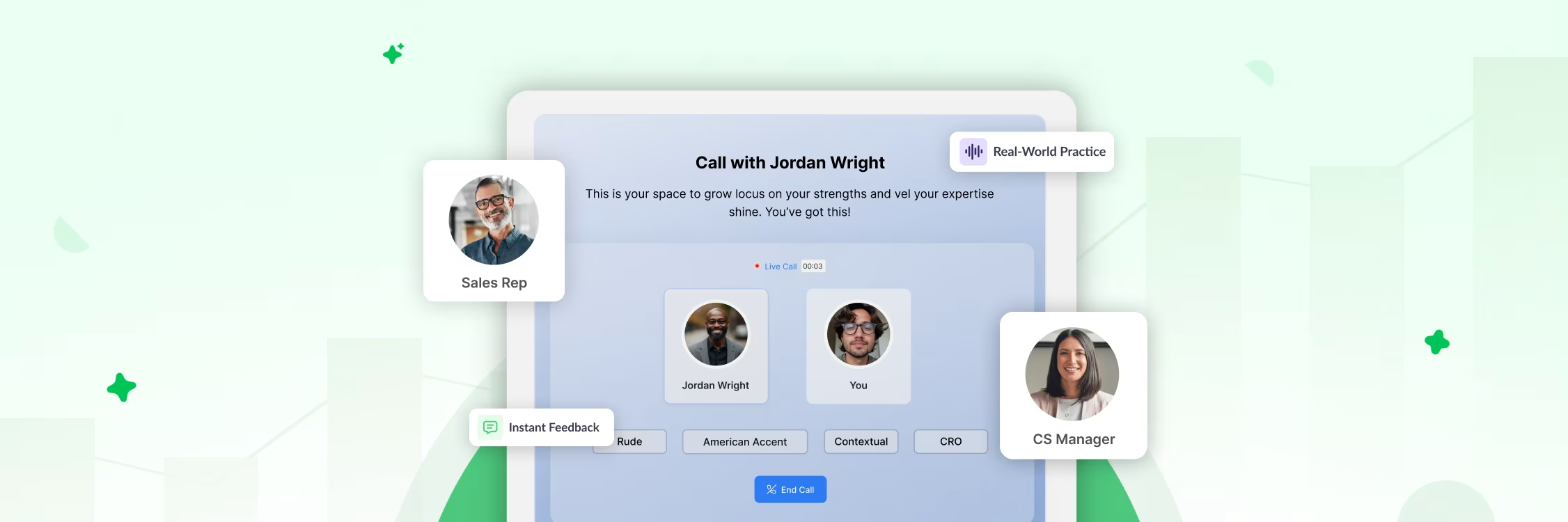
AI roleplays give experienced reps a way to quickly personalize their approach for each conversation, helping them calibrate what will land with this specific prospect - not relearn the basics. GTM Buddy provides realistic, in-workflow simulations tied to real messaging, objections, personas, product updates and competitive signals - letting reps test and refine judgment in a safe environment.
The result: sharper discovery, stronger executive conversations, better competitive differentiation, and more consistent deal progression. For enablement, it creates a measurable link between training, execution, and revenue - turning readiness into a living system, not an event.
----
The Prospect Has Already Formed an Opinion Before You Show Up
Prospects now build their view of the market long before they interact with sales, following a predictable sequence that mirrors what Forrester describes in Buying Networks: Your Buyers’ New Reality. Prospects operate as dynamic groups that form opinions, exchange information, and shape consensus well before a seller is ever invited into the process.
They begin with AI research. Tools like ChatGPT, Perplexity, and Claude help them understand categories, compare vendors, and form an early hypothesis about what might work for them.
They look for proof in the market. Platforms such as G2 and Gartner Peer Insights give them patterns to anchor on: where products deliver, where they fall short, and which claims feel consistently validated by real customers.
They listen to real practitioners. They follow operators on LinkedIn, participate in niche Slack communities, and consume content from hands-on experts. These voices feel credible because they reflect real experience rather than polished marketing narratives.
By the time they reach a seller, their point of view is largely set. They are not exploring. They are checking for alignment with the narrative they have already formed.
Meanwhile, competitors are adapting their messaging in real time. Positioning shifts driven by prompts, new outbound angles, and fast pricing experiments create constant motion in the market. As a result, sellers often walk into conversations where the prospect’s context is already several steps ahead of the sales team’s enablement cycle.
Senior reps feel this more than anyone. Their instincts still matter, but they need a way to refresh and recalibrate those instincts at the speed the market moves.
This is the environment that forces a redefinition of readiness.
Readiness Isn’t Memorization Anymore - It’s Orientation
The challenge modern reps face isn’t knowledge. It’s orientation. What they need now is the ability to personalize their preparation for each specific account and buyer, so they walk in already aligned to that prospect’s context, priorities, and decision lens.
The buyer’s frame may have shifted since last week, but reps rarely have direct visibility into these shifts. Instead of guessing at internal changes - such as revised budgets, consolidation priorities, or implementation risk concerns - senior reps need ways to ground their preparation in signals they can observe.
This is where personalized AI roleplays help. GTM Buddy generates roleplays that mirror the exact account, persona, and moment a rep is about to face by pulling in current messaging, recent objections, latest product updates, competitive signals, and deal‑specific context. Reps can prepare for how real conversations are likely to unfold, even without direct visibility into internal buyer dynamics.
In this environment, readiness becomes the ability to read a room whose dynamics move faster than the team’s training cadence.
Consider Ron’s example, who is our Head of Sales at GTM Buddy. Minutes before what should have been a standard discovery call, he learned that the prospect’s CEO was joining. The preparation premise changed instantly: if the dynamics shift, your preparation should shift with it.
He needed to understand not just the business but how this specific leader processes information, challenges assumptions, and guides conversations.
Instead of relying purely on instinct, Ron used GTM Buddy’s AI roleplay to generate a realistic simulation of how that executive speaks, interrupts, evaluates value, and responds under pressure.
He ran a quick, targeted practice round - not to memorize lines, but to adjust pacing, framing, and the depth of his questions.
When the real call happened, the difference was immediate. The CEO noticed the preparation. The conversation moved with more clarity. Objections became easier to navigate. The meeting ended with acknowledgment that Ron "understood where he was coming from."
Here's Ron recounting the experience
This is what real readiness looks like: walking in already aligned to the executive’s level, pacing, and priorities.
Traditional preparation can’t deliver that. Real-time AI roleplays can.
The World Has Outgrown Traditional Practice
Enablement teams feel this more acutely than anyone. Workshops become outdated within weeks. Playbooks are stale the moment a new competitor launches a feature. Objection patterns shift faster than content teams can produce counterpoints.
But the deeper problem isn’t the velocity of change - it’s the fragmentation of change.
A single deal today can involve:
- a champion focused on workflow pain,
- a VP concerned about change management risk,
- a CFO anchoring on cost reduction,
- a procurement lead pushing for vendor consolidation,
- and an IT leader focused on compliance.
Each of these personas functions like its own micro-market. And they don’t move in sync.
Traditional practice - scripted, event-based, infrequent - prepares reps for a static world where the buying process is linear. But reps are now selling in a world where every conversation is a moving target.
GTM Buddy’s AI roleplay shifts this because it reflects live inputs: fresh objections, recent call notes, new messaging pushes, new persona insights. Practice stops being a backward-looking exercise. It becomes a real-time calibration system.
AI-Native Readiness: Practice That Adapts as Fast as the Market
Senior reps don’t need foundational training. What they need is a way to refine their judgment for the specific deals in front of them. Their strength has always been instinct, but instinct only works when it’s calibrated to the buyer, the account, and the moment.
They’re working across new industries, changing buying groups, and shifting economic and AI‑driven expectations. The goal isn’t to undo old patterns, but to make sure their experience stays relevant in a market that changes faster than most deals progress.
Their intuition was shaped in a predictable world - but today, predictability is a luxury.
AI roleplays become the sandbox senior reps didn’t know they needed. When GTM Buddy delivers a scenario built from the company’s latest messaging, the newest competitive shifts, and the most recent objections surfaced in the field, senior reps get something they rarely get: a space to test new mental models.
Experienced sellers don’t just need realism - they need a practice environment that’s easy to access, effortless to spin up, and unlimited in how many reps or scenarios they can run.
They can rehearse unlimited variations of the same moment - a CFO pushing on cost, a skeptical VP challenging ROI, a cross-functional committee raising conflicting priorities - each one shifting dynamically based on how they respond.
Because the environment is frictionless, reps actually use it. They jump in before a call, after a tough objection, or when they need to sharpen a narrative for a new vertical. They can experiment freely, iterate quickly, and practice as much as they need without risking credibility or pipeline.
This isn’t training. It’s the easiest, safest way for experienced sellers to pressure-test their thinking before it reaches a real buyer - so the first time they meet resistance isn’t when the deal is on the line
Coaching That Focuses on the Real Work
Managers want to coach well - but most of their time gets lost in trying to figure out what to coach. They sit through calls, sift through notes, or rely on gut feel to identify where a rep struggled. By the time they get to the actual coaching conversation, the rep is already juggling the next deal.
GTM Buddy changes that dynamic entirely. Every roleplay generates structured, objective feedback: discovery depth, clarity of value articulation, how well the rep tied pain to impact, whether they framed ROI properly, how they handled pushback, and where the narrative drifted.
Instead of managers hunting for signals, the system surfaces them:
- patterns in how reps respond under pressure,
- the objections that repeatedly throw them off,
- where conversations become too feature‑heavy,
- where they miss executive‑level framing,
- which parts of discovery consistently stay shallow.
And because all this data rolls up into reporting, managers can coach with relevance instead of broad advice. They know exactly which moments stall progress - not based on opinion, but on repeated patterns captured across simulations.
Reps benefit just as much. Feedback stops feeling personal. It’s not “my manager didn’t like how I handled that call.” It becomes, “Across five simulations, I consistently rushed past problem diagnosis,” or “I lose momentum when a CFO challenges ROI.” It’s grounding, not subjective.
And when managers add comments or guidance inside GTM Buddy, it stays tied to the rep’s roleplays - so both sides walk into coaching conversations already aligned on what matters.
The result is simple: managers spend less time diagnosing and more time improving the parts of selling that actually influence deals. GTM Buddy gives them leverage, not another task.
How AI Roleplays Drive Real Improvements in Live Deals
For experienced sellers, performance isn’t measured by how well they know the pitch - it’s measured by how reliably they can drive a deal forward in a buyer environment that changes week to week. Their value shows up in the moments the business counts on them for: navigating a CFO’s pushback, aligning a fractured buying group, reframing value when budgets shrink, and sustaining deal momentum when priorities shift.
That’s the expectation placed on them. And it’s exactly where GTM Buddy creates impact.
Because every AI roleplay ties directly to the company’s latest messaging, content, competitive insights, and product updates, senior sellers aren’t practicing theory - they’re practicing the exact moves the business needs them to execute. When they rehearse with GTM Buddy, they’re sharpening the narratives PMM just rolled out, the competitive counters product marketing published this week, and the objection patterns surfacing in the field right now.
And because GTM Buddy links roleplay performance, content usage, and live deal activity, you can actually see the connection between practice and revenue moments:
- Sellers who improve discovery depth in simulations uncover stronger business impact stories in deals.
- Sellers who train on competitive scenarios create cleaner differentiation in head-to-head cycles.
- Sellers who refine ROI framing show up more credible in executive conversations.
- Sellers who practice multi-threading scenarios navigate committees with more control, not luck.
These aren’t small improvements - they’re the moments that keep a deal alive.
For senior reps, it means showing up sharper and more adaptable in the situations where the team depends on them most. For enablement, it means readiness is no longer abstract - you can point to the exact skills practiced and the exact impact they had on pipeline.
This is the real outcome: a direct, visible line between training, execution, and revenue. And when experienced sellers operate with that level of consistency, win rates don’t just improve - they stabilize across the team.
What Enablement Leaders Must Do NextThe Call to Enablers
Enablement teams have always fought the tension between speed and rigor. Today, that tension is wider than ever.
The market won’t wait. Buyers won’t decelerate. Competitors won’t slow their cycles. Sales teams won’t magically adapt without intervention.
AI roleplays - especially when delivered in workflow, connected to content, and updated dynamically - are how readiness catches up to the environment.
It’s not another tool. It’s the infrastructure for predictable execution in a market that refuses to stay still.
Explore how GTM Buddy’s AI Roleplay helps teams adapt faster, practice continuously, and stay aligned in every deal moment.
FAQs
1. Why do experienced sellers need AI roleplays more than new reps?
Because the market has shifted faster than the patterns senior reps rely on. Their instincts still matter, but they need a way to refresh them continuously as buyer behavior, competitive narratives, and economic pressures evolve.
2. How have AI tools like ChatGPT changed the buying environment?
Buyers now form opinions before speaking to sales. They research vendors, compare alternatives, analyze features, and validate their assumptions through communities and reviews - arriving with a pre-shaped narrative sellers must navigate.
3. What makes GTM Buddy’s AI roleplays different from generic simulations?
They’re grounded in live GTM inputs: updated messaging, latest competitive notes, fresh objections from the field, and persona insights. Every scenario reflects what’s happening right now, not last quarter.
4. How do AI roleplays help reps prepare for executive conversations?
Reps can simulate exec-level pacing, lenses, and objections in advance. GTM Buddy mirrors how real leaders think and challenge - so reps walk in oriented, not guessing.
5. How easy is it for reps to use GTM Buddy’s AI role play?
There’s no setup. From Slack, CRM, or the browser extension, reps click “Practice this conversation” and instantly spin up a tailored simulation. Unlimited practice, zero friction.
6. Does this replace coaching from managers?
No - it makes coaching more precise. GTM Buddy identifies patterns like weak discovery, poor ROI framing, or narrative drift. Managers skip diagnosis and focus directly on improvement.
7. How does GTM Buddy connect practice to actual revenue outcomes?
Because practice, content usage, and live deal activity all roll up into one system. You can see how improvements in simulation lead to deeper discovery, cleaner differentiation, and stronger executive performance in real calls.
8. What impact does this have on senior sellers specifically?
They become more adaptable - navigating CFO pushback, cross-functional committees, shifting priorities, and competitive pressure with more confidence and consistency.
9. Why is AI roleplay becoming foundational for enablement teams?
Because readiness must evolve as fast as the market. AI roleplays are always current, delivered in-workflow, and tied to GTM strategy - making them the infrastructure for consistent execution, not just another tool.