
How Keelvar Unlocked 15% More Revenue Capacity Per Rep Without Adding Headcount
.svg)
multi-stakeholder cycles
conversion lift
hitting target
productive quarter
The Constraint: Retrieval Paralysis at Scale
As Keelvar scaled its revenue team, a structural problem emerged that looked like a content problem.
Content was scattered across Google Drive, Slack, HubSpot, and email threads. Reps searching for the right asset before a call were averaging 7 minutes per search - not because they were inefficient, but because the system was architected for storage, not retrieval. By the time a rep located the right deck, the moment had often passed.
The team was burning 40 hours a week collectively just hunting for assets. That is a full-time hire's worth of selling time lost to search - every single week.
"We were burning 40 hours a week just hunting for assets. GTM Buddy gave us a better way, and the onboarding support was genuinely great."
The secondary effect was harder to measure but more damaging: when the right asset was too hard to find, reps defaulted to outdated or generic content. Keelvar's product was evolving rapidly - and sellers were improvising answers to product questions instead of delivering current, accurate messaging.
Marketing had zero visibility into what was actually being used. 60% of content was functionally invisible.
Sales managers could see outcomes. They could not see the deal while it was live. Coaching happened in retrospect - after the loss, not before it.
This was not a content problem. It was an architecture problem.
The system had been designed to store intelligence. Nobody had designed it to deliver intelligence at the moment it was needed.
The Architectural Shift: From Library to Heads-Up Display
Keelvar's leadership recognised that better organisation would not solve the underlying constraint. The problem was not that assets were hard to find. The problem was that reps had to leave their workflow to find them at all.
GTM Buddy introduced a different architecture. Instead of building a better library, it deployed a Heads-Up Display - injecting the right content, context, and intelligence directly into Gmail, HubSpot, Slack, and Nooks, at the moment of execution, without requiring reps to change how they worked.
"With GTM Buddy, our reps are able to locate all the relevant assets within minutes. Ask Buddy is my favourite - I just type in a question about a competitor or product and it gives me exactly what I need."
The shift was not incremental. It was structural. Content stopped waiting to be found. Signal started arriving where reps already were.
What Changed - and Why It Compounded
CONTENT VELOCITY
GTM Buddy replaced fragmented content sources with a centralised activation layer that auto-tagged and surfaced assets by persona, deal stage, and use case. Content discovery dropped from 7 minutes to under 2 minutes - a 70% reduction.
But the number that mattered was not time saved. It was what reps did with the capacity reclaimed. More active deals. Better-prepared conversations. Consistent asset usage across the full team, not just the veterans who knew where things lived.
Marketing asset utilisation rose 60% - not because reps were reminded to use content, but because the content appeared where they were already working.
IN-FLOW ACTIVATION
Keelvar's product evolves fast. Under the old model, that velocity created execution risk: reps improvised answers, delivered stale messaging, and lost confidence mid-deal on product questions.
Ask Buddy resolved this by surfacing real-time answers to product updates, competitive intelligence, and messaging guidance - inside the workflow, without a Slack thread, without waiting on enablement.
"Keelvar is a fast-evolving product, and sellers have a lot of questions about it. Ask Buddy has helped them quickly find those answers, which in turn has helped improve our deal velocity."
RAMP ACCELERATION
New reps at Keelvar now onboard against a live, AI-powered knowledge system - not a static playbook that is outdated before the first call. As the product changed, the system updated. Everboarding replaced the assumption that training was a one-time event.
Ramp time to first productive quarter dropped 40%. Every week shaved off ramp time is a week of quota-bearing capacity recovered - without a new hire.
REVENUE PROOF
GTM Buddy's content engagement analytics gave Keelvar's marketing team pipeline-level visibility for the first time: which assets influenced deals, which personas engaged, and where gaps existed. Enablement decisions shifted from instinct to evidence.
Marketing could now build based on what moved revenue - not what got views.
The Revenue Proof: Capacity Math
The standard way to report these results would be to list productivity gains. That would miss the point. What Keelvar unlocked was revenue capacity from the same team — without adding headcount. Here is what the numbers actually represent:
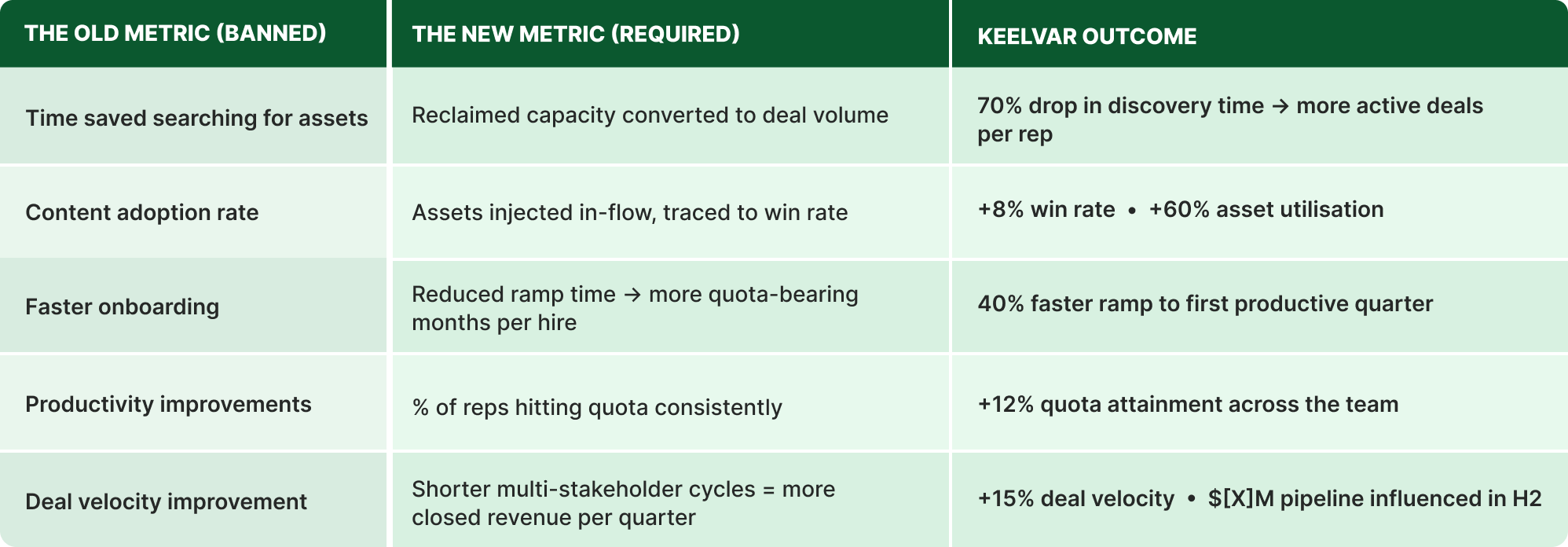
Note: $[X]M pipeline influenced figure to be confirmed with Keelvar. All other figures reflect team-wide outcomes over the measurement period.
The Lasting Impact: Infrastructure, Not Initiative
GTM Buddy did not fix Keelvar's content problem.
It made the content problem irrelevant.
What changed was the architecture. Reps stopped spending cognitive load on retrieval and started spending it on judgment. Managers gained visibility into live deals - not post-mortems. Marketing built on evidence, not instinct.
The compounding effect is the point. When content velocity improves, reps run more active deals. When in-flow activation works, product questions get answered in real time. When ramp acceleration kicks in, new hires contribute earlier. When revenue proof exists, enablement gets funded - and the cycle reinforces itself.
Pull one lever and you fix a moment. Pull all four and you transform the system.
Keelvar's revenue organisation now runs on shared intelligence. The Activation Engine powering it does not depend on hero reps, heroic effort, or headcount additions. It depends on a system that makes consistent, high-quality execution the default - across every rep, every deal, every quarter.
That is Revenue Activation. And for Keelvar, it is now infrastructure.