
16/16/27 Framework
A proprietary GTM Buddy framework defining the optimal human-AI division of labor in the Agentic Era of Sales. Sixteen tasks belong entirely to AI, sixteen tasks belong entirely to humans, and twenty-seven tasks are executed together. The core principle: AI owns the work around the conversation; humans own the conversation itself.
Account-Based Marketing (ABM)
An account-focused go-to-market strategy in which marketing and sales coordinate around a defined set of high-value accounts rather than broad lead volume. ABM creates sharper targeting and better message alignment, but it still needs Revenue Activation to influence what happens in the live deal once the account is in motion.
Account-Based Selling (ABS)
A B2B sales approach in which the seller coordinates activity across multiple stakeholders within a target account rather than pursuing individual contacts. ABS demands precise content delivery and tight messaging for each stakeholder tier. In a Revenue Activation model, ABS execution is supported by in-flow guidance that adapts to account context and stakeholder signal in real time.
Acceleration Play
A named proprietary GTM Buddy play designed for high-velocity deal execution. The Acceleration Play activates a specific combination of the Five Levers to move deals through a compressed timeline. It is one of GTM Buddy's core proprietary execution frameworks alongside the Foundation Play.
Activation Surface
Any channel, interface, or tool where GTM Buddy delivers contextual guidance, content, or next-best-action cues to a rep in the flow of work. Common activation surfaces include CRM interfaces, Slack and Teams messages, email clients, meeting tools, and Digital Sales Rooms. The activation surface is where Context Architecture makes contact with the live deal.
Agentic Era of Sales
The current phase of B2B selling in which AI handles the work around the conversation — prep, retrieval, follow-up, CRM hygiene, and coaching cues — so human sellers can focus their attention, judgment, and relationship intelligence on the conversation itself. The Agentic Era of Sales does not diminish the rep; it uncaps their human agency by removing everything that was consuming it.
Agentic Sales Rep
A seller operating in the Agentic Era of Sales whose human agency is fully uncapped because the system removes administrative friction. The Agentic Sales Rep does not search for context, stitch together information, and then try to decide. The system handles retrieval and activation so the rep can focus on judgment, relationships, and live execution.
Agentic Sales
Agentic Sales is the broader operating model for the Agentic Era of Sales. It describes a sales environment in which AI handles more of the work around the conversation so human sellers can focus on judgment, deal strategy, and buyer interaction. Revenue Activation is the execution system that makes Agentic Sales work in practice.
Agentic Sales Platform
An Agentic Sales Platform is software designed to support Agentic Sales by combining AI assistance, workflow integration, signal detection, and contextual guidance. GTM Buddy's position is stronger and more precise than generic agentic sales platform language: it is the Revenue Activation Engine for the Agentic Era of Sales.
Agentic Workflow
A workflow that senses context, adapts as new deal information appears, and continues progressing work instead of following a rigid sequence. Agentic workflows matter because live selling rarely follows a clean linear path. Revenue Activation depends on workflows that can respond to signals instead of waiting for manual intervention.
AI Sales Assistant
A software agent that performs discrete sales tasks — drafting emails, summarizing calls, updating CRM fields, surfacing relevant content — within the seller's workflow. In a Revenue Activation model, AI Sales Assistants function as components of the activation layer rather than standalone productivity tools. Productivity is time saved; Revenue Activation is capacity unlocked.
AI Copilot
An AI assistant that works alongside the rep by suggesting actions, drafting outputs, surfacing relevant information, or summarizing context without independently running the system. An AI copilot is useful, but Revenue Activation is broader: it requires execution architecture, not just an assistant interface.
AI Hallucination
An AI failure mode in which the model produces information that sounds confident but is false, unsupported, or mis-grounded. In revenue work, hallucinations are especially dangerous because they can put inaccurate messaging, competitive claims, or buyer guidance into a live deal. That is why grounding and content governance matter.
AI Meeting Prep
The use of AI to assemble an account brief before a call by combining CRM history, stakeholder context, recent interactions, likely objections, and recommended next steps. In a Revenue Activation model, AI Meeting Prep is valuable because it reduces last-minute research overhead and improves the quality of the rep's judgment before the conversation begins.
AI Role Play
The use of AI to simulate sales conversations, objections, negotiations, or discovery scenarios so reps can practice against realistic conditions. AI Role Play supports Ramp Acceleration and Coaching Precision by compressing the learning curve before the rep enters a live deal. It also helps GTM Buddy capture adjacent search demand around roleplay ai and modern sales training without collapsing the category into generic coaching software.
Battlecard
A structured competitive reference document that equips a rep to handle objections, counter competitor positioning, and differentiate in live deal conversations. In a Revenue Activation model, battlecards are not stored in a library and retrieved manually; they are injected at the deal moment when a competitive signal is detected. Delivery speed is the differentiator.
Buyer Enablement
The practice of equipping buyers — not just sellers - with the information, resources, and tools they need to navigate an internal purchase decision. Buyer enablement is distinct from seller enablement: the rep enables the champion to sell internally. Digital Sales Rooms are a common buyer enablement surface in modern B2B sales.
Buyer Journey
The sequence of decisions and interactions a prospect completes from initial awareness through signed contract. Revenue Activation maps the buyer journey to specific activation moments: when the rep needs a particular piece of content, a coaching cue, or a next-best-action recommendation to keep the deal moving.
Buyer Intent Signal
Any observable clue that a buyer is actively evaluating a problem, a vendor, or a next step. Buyer intent signals can come from engagement patterns, language, timing, stakeholder behavior, or deal activity. In a Revenue Activation model, the point is not just to notice the signal but to respond before momentum fades.
Causal Measurement
A measurement approach that links a specific activation input a piece of content delivered, a coaching cue accepted, a guided next-best-action taken to a downstream revenue outcome at the rep or deal level. Causal measurement is the opposite of correlational reporting, which shows that training and revenue moved in the same direction without proving that one caused the other. Revenue Proof, one of the Five Levers, is GTM Buddy's mechanism for causal measurement.
Choke Point
An execution constraint that prevents a rep from converting readiness into revenue in a live selling moment. Common choke points include delayed content retrieval, inconsistent objection handling, unclear next steps, and absent coaching during critical deal stages. Revenue Activation is built to detect and remove choke points at the moment they appear.
Coaching Precision
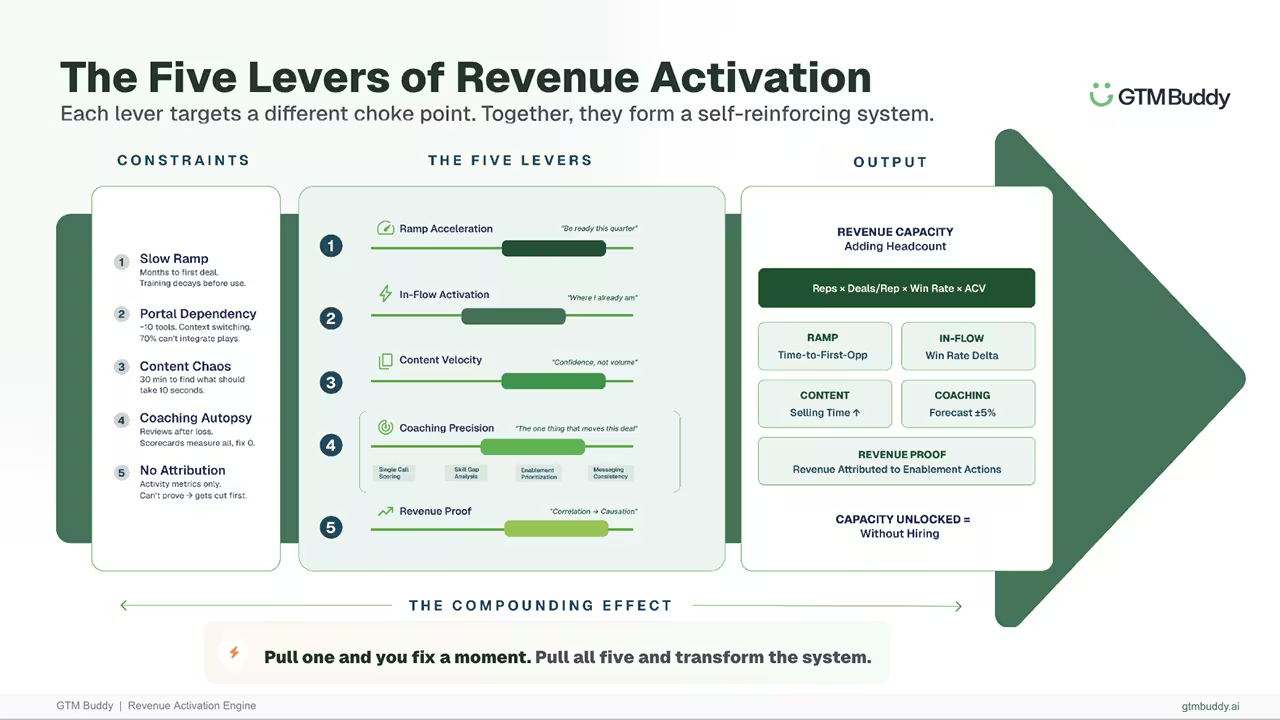
One of the Five Levers of Revenue Activation. Coaching Precision delivers the one adjustment that moves a deal forward at the right moment, in the right deal, for the right rep rather than delivering generic post-mortem feedback after the moment has passed. Precision replaces volume: one correct coaching intervention at the right time produces more deal impact than ten retrospective reviews.
Competitive Intelligence
The insight a revenue team gathers about competitor positioning, deal patterns, objection themes, and message weaknesses. In Storage Architecture, competitive intelligence sits in folders as battlecards. In Revenue Activation, it is surfaced in the moment a competitive signal is detected and tied to the live opportunity.
Content Activation
The shift from simply managing assets to making them influence live deal behavior. Content activation asks not whether content exists, but whether the right content appears when it can change the outcome of a conversation, meeting, or stakeholder decision.
Content Governance
The system of rules, approvals, version controls, and tagging structures that determine which content is accurate, approved, and safe to deploy in live deals. Without content governance, Content Velocity becomes a liability: reps deliver outdated or off-message assets at critical deal moments. Revenue Activation depends on clean content governance at the infrastructure layer.
Content Velocity
One of the Five Levers of Revenue Activation. Content Velocity ensures that the right asset appears in the right deal at the right moment not because the rep searched for it, but because the system detected the deal signal and delivered it. The measurement of Content Velocity is not how much content exists; it is how often the right content reaches the rep at the moment it can change deal behavior.
Context Architecture
GTM Buddy's defining architectural model, and the structural alternative to Storage Architecture. Context Architecture operates through three mechanisms: signal detection, contextual injection, and workflow integration. Rather than storing assets for manual retrieval, Context Architecture detects what is happening in the deal and activates the right response inside the rep's existing workflow.
Conversational Intelligence
Technology that captures, transcribes, and analyzes sales conversations calls, meetings, demos to surface patterns, objection frequency, talk-time ratios, and deal risk signals. In a Revenue Activation model, conversational intelligence feeds signal detection: what was said in the call becomes an input for the next activation, coaching cue, or content recommendation.
CRM (Customer Relationship Management)
The primary system of record for pipeline, contacts, accounts, deal stages, and activity history in a B2B sales organization. CRM is the data backbone of Revenue Activation: it provides deal context for signal detection and serves as an activation surface for in-flow guidance and next-best-action delivery.
Deal Signal
Any observable event or pattern in a deal that indicates a risk, opportunity, or required action a missed follow-up, a stalled stage, a new stakeholder, a competitor mention, a pricing objection. Deal signals are the input layer of Context Architecture. GTM Buddy's Nucleus reads signals and triggers the appropriate activation response.
Deal Intelligence
The structured understanding of what is happening inside an active opportunity: the stakeholder map, risk profile, momentum, engagement quality, and likely next moves. Deal intelligence becomes much more valuable when it is used to drive activation in real time rather than sit in a dashboard after the fact.
Digital Sales Room (DSR)
A shared digital workspace where reps and buyers collaborate on deal content, proposals, mutual action plans, and stakeholder updates. Digital Sales Rooms are activation surfaces in the Revenue Activation model, not the activation engine itself. GTM Buddy can use DSRs as the delivery point for contextually activated content at the buyer-facing deal moment.
Discovery Call
The early-stage conversation in which a rep qualifies the prospect, surfaces pain, and maps the buyer's situation to a potential solution. In a Revenue Activation model, the discovery call is a primary signal source: what the rep learns in discovery should automatically update deal context and trigger relevant activation for the next stage.
Execution Architecture
The structural design of a revenue system that determines how reps execute in live selling moments. Legacy systems operate on preparation architecture: train the rep before the moment. Revenue Activation operates on execution architecture: support the rep inside the moment, using signal detection and in-flow activation to remove friction as it appears.
Execution Friction
The sum of administrative, informational, and structural obstacles that prevent a rep from executing their best work in a live selling moment. Execution friction includes time spent searching for content, figuring out next steps, waiting for manager input, and updating CRM fields. Revenue Activation removes execution friction so that rep capacity already present can convert into revenue.
First-Line Manager
The sales manager who directly oversees a team of account executives or sales reps. In most sales organizations, the first-line manager is the primary coaching resource and forecast accountability holder. In a Revenue Activation model, Coaching Precision scales the first-line manager's impact by surfacing the one deal-specific coaching intervention that matters at each stage.
Five Levers
The five dimensions through which GTM Buddy activates revenue capacity from the existing team: Ramp Acceleration, In-Flow Activation, Content Velocity, Coaching Precision, and Revenue Proof. Each lever targets a distinct execution constraint. Together, they form the complete Revenue Activation system. The power is not in any single lever; it is in all five operating as one coordinated activation engine.
Forecast Accuracy
The degree to which a sales organization's predicted pipeline outcome matches actual close rates, revenue, and timing. Forecast accuracy degrades when deal execution is inconsistent, rep behavior is unpredictable, and coaching is reactive. Revenue Activation improves forecast accuracy by reducing execution variance across the team.
Foundation Play
A named proprietary GTM Buddy play for establishing repeatable execution infrastructure inside a revenue organization. The Foundation Play activates the Five Levers systematically to build a baseline of consistent deal behavior across the team before layering in velocity and acceleration. It is the starting play for organizations moving from Storage Architecture to Context Architecture.
Go-To-Market (GTM)
The strategic and operational plan for how a company brings a product or service to market, covering positioning, sales motion, channel strategy, and revenue execution. GTM strategy defines the motion; Revenue Activation is the infrastructure that ensures the motion is executed consistently in live deals rather than only in training rooms and slide decks. This is relevant to both go to market strategy and GTM strategy conversations because execution quality determines whether strategy survives contact with the field.
Go-to-Market Intelligence
The broader set of insights that helps revenue teams understand markets, buyers, competitors, and message performance. Go-to-market intelligence sharpens decisions upstream; Revenue Activation ensures those decisions are expressed correctly in the workflow when the deal is active.
Hero Dependency
A revenue pattern in which a small number of top-performing reps carry a disproportionate share of the team's quota attainment. Hero dependency is a structural risk: when heroes leave, quota falls. Revenue Activation addresses hero dependency not by replicating heroic behavior, but by removing the structural friction that prevents average reps from executing well in live deal moments.
Ideal Customer Profile (ICP)
The definition of the type of company most likely to succeed with your product, based on fit, buying conditions, and value realization. ICP sharpens account selection and message relevance. In a Revenue Activation model, ICP logic should shape the content, guidance, and next-best-action recommendations delivered to the rep.
In-Flow Activation
One of the Five Levers of Revenue Activation. In-Flow Activation delivers guidance, content, and next-best-action recommendations inside the rep's existing workflow in CRM, email, Slack, or the meeting tool at the exact moment a selling decision is being made. In-Flow Activation does not interrupt the workflow; it enhances it from the inside.
In-Flow Guidance
The act of delivering contextually relevant coaching, content, or process direction to a rep within the tool or interface they are already using, without requiring them to context-switch to a separate system. In-flow guidance is the delivery mechanism of In-Flow Activation, one of the Five Levers, and the defining characteristic of Context Architecture in practice.
Just-in-Time Enablement
An enablement approach that delivers support, content, and coaching at the moment of need before a specific call, after a specific objection, or during a specific deal stage rather than in advance through scheduled training programs. Just-in-time enablement is the operational principle behind In-Flow Activation and Coaching Precision.
Knowledge Transfer
The process of moving expertise, process knowledge, and institutional memory from experienced reps and managers to newer or lower-performing reps. In traditional sales orgs, knowledge transfer happens through shadowing, recorded calls, and playbooks. Revenue Activation systematizes knowledge transfer through signal-triggered guidance delivery, so the right knowledge reaches the right rep at the right deal moment.
Learning Reinforcement
The process of making knowledge stick through repetition, contextual reminders, and use in real work. Revenue Activation depends on learning reinforcement because one-time training decays fast. Reps remember and improve when the right skill cue reappears in the moment they need it.
Live Deal Guidance
Deal-specific guidance surfaced while the rep is actively working an opportunity. Live deal guidance is one of the clearest expressions of Revenue Activation in practice because it turns signal detection into immediate help inside a real moment rather than delayed advice after the fact.
LMS (Learning Management System)
A software platform used to deliver, track, and manage formal training and learning programs for sales teams. An LMS is preparation infrastructure: it gets the rep ready before the moment. In a Revenue Activation model, the LMS is part of the Ramp Acceleration lever, and its value increases when learning is connected to live deal activation rather than treated as a standalone system. This is where traditional sales training starts, but not where execution improvement ends.
Multi-Threaded Deal
A sales deal in which the rep actively maintains relationships and communication with multiple stakeholders across the buyer organization rather than a single contact. Multi-threading reduces deal risk and increases win rate. In a Revenue Activation model, multi-threading is supported by contextual content delivery and guidance specific to each stakeholder's role and concerns.
Mutual Action Plan
A shared document typically between the rep and the buyer that outlines the agreed steps, owners, and timelines required to reach a purchase decision. Mutual Action Plans are a buyer alignment tool and a deal hygiene signal: when both parties commit to a shared plan, deal momentum increases and forecast risk decreases.
Next-Best Action
The specific recommended step a rep should take next in a deal based on deal stage, buyer signals, historical patterns, and current context to advance toward close. Next-best-action recommendations are a core output of Context Architecture: the system processes deal signals and surfaces the one move most likely to move the deal forward at that moment.
Nucleus
GTM Buddy's core activation engine. The Nucleus is the intelligence layer that ingests deal signals, processes context, and coordinates activation across the Five Levers. Every in-flow activation, coaching cue, and content delivery in the GTM Buddy platform is coordinated through the Nucleus.
Subscribe to Elevate,
our bi-weekly newsletter.
Get the most interesting stories from the world of sales and revenue enablement every alternate week.
Objection Handling
The set of techniques and responses a rep uses to address buyer concerns, challenges, or resistance during a sales conversation. In a Revenue Activation model, objection handling is not a skill trained in advance and forgotten; it is activated at the moment an objection signal is detected, with the specific response most likely to move that deal forward delivered in-flow.
Onboarding (Sales Onboarding)
The structured process for bringing new sales hires from their first day to full productivity and quota attainment. Onboarding is the primary use case for Ramp Acceleration, one of the Five Levers. Most sales onboarding programs fail not because they lack information, but because they are disconnected from live deal execution new reps learn in isolation and then execute alone.
Pipeline
The aggregate of active opportunities at various stages of the sales process, representing potential future revenue. Pipeline is both a measurement tool and an execution surface: Revenue Activation improves pipeline quality not by adding more deals, but by improving the execution quality of deals already inside it. In plain terms, it improves the sales pipeline by making the deals already in motion more executable.
Pipeline Conversion
The rate at which opportunities move from one stage to the next and ultimately close as revenue. Pipeline conversion is one of the clearest ways to see whether activation is improving execution quality across the funnel rather than simply increasing top-of-funnel activity.
Playbook
A structured guide that defines the recommended process, messaging, objection responses, and next steps for a specific sales scenario an industry, a competitor, a deal stage, or a product motion. In Storage Architecture, playbooks are documents reps retrieve and read. In Context Architecture, playbook content is delivered in-flow at the moment the scenario is detected.
Prompt Guardrails
The rules, constraints, grounding instructions, and source controls that keep AI-generated outputs accurate, safe, and on-message. Prompt guardrails matter in Revenue Activation because low-quality AI guidance can contaminate live deal execution faster than a bad static document ever could.
President's Club
The top-performer recognition program in most B2B sales organizations, typically reserved for the 10–15% of reps who exceed a defined quota threshold. President's Club is the primary outcome metric of Revenue Activation: the goal is to increase the number of reps who reach President's Club, not just the handful of heroes who would have gotten there without any system support.
Quota Attainment
The percentage of a rep's sales quota achieved within a measurement period. Low quota attainment is the most visible symptom of revenue capacity being buried under execution friction. Revenue Activation improves quota attainment by removing the constraints that prevent reps who have the skills from converting those skills into closed revenue.
Quota Capacity
The amount of quota performance a team could realistically unlock if execution friction were removed and more reps operated closer to their actual selling capacity. Quota capacity is a useful bridge concept for revenue leaders who already think in attainment terms but need a better explanation for untapped performance.
Ramp Acceleration
One of the Five Levers of Revenue Activation. Ramp Acceleration reduces the time it takes for a new sales hire to move from onboarding to consistent, quota-contributing revenue execution. The mechanism is not more training content it is earlier exposure to live deal activation, so the new rep learns inside real selling moments rather than in simulated preparation.
Ramp Time
The elapsed time between a new rep's start date and their first full quota-attainment period. Ramp time is one of the highest-leverage metrics in a sales organization: every week shortened is a week of revenue capacity unlocked. Revenue Activation targets ramp time through the Ramp Acceleration lever by connecting structured learning to live deal execution from day one.
Readiness-to-Execution Gap
The distance between what teams teach, document, and prepare for and what reps actually do in the field. The Readiness-to-Execution Gap is where content gets ignored, coaching arrives too late, and rep performance becomes inconsistent. Revenue Activation exists to close that gap.
Revenue Activation
See the Featured Definition above for the full first-principles treatment.
Revenue Activation is a sales operating system that removes execution friction across five dimensions Ramp Acceleration, In-Flow Activation, Content Velocity, Coaching Precision, and Revenue Proof to unlock the full revenue capacity of each rep without adding headcount. It operates inside the selling moment, not before it. GTM Buddy is the Revenue Activation Engine.
Revenue Activation Engine
The system and GTM Buddy's product category identity that executes Revenue Activation across all five levers simultaneously. An engine implies active, coordinated work: detecting signals, injecting activation, measuring outcomes, and improving over time. Unlike a repository or a training platform, the Revenue Activation Engine operates inside the live deal.
Revenue Activation Framework
The structured methodology for deploying Revenue Activation inside a revenue organization, covering signal detection, lever sequencing, measurement design, and outcome tracking. The Revenue Activation Framework is the operating model that determines how the Five Levers are configured and prioritized for each team's specific execution constraints.
Revenue Activation Index
A proprietary GTM Buddy measurement framework that quantifies a revenue organization's activation health across the Five Levers. The Revenue Activation Index produces a causal, lever-by-lever view of where execution friction is highest and which levers are delivering the most impact moving measurement from activity correlation to outcome causation.
Revenue Activation Platform
The software category that houses systems like GTM Buddy purpose-built to detect deal signals, deliver in-flow activation, and measure revenue outcomes at the rep and deal level. The Revenue Activation Platform category is structurally distinct from Sales Enablement platforms: it is built for execution, not preparation; for context, not storage; for causation, not correlation. The same idea can also be expressed as Revenue Activation Software or a Revenue Activation System, but GTM Buddy should lead with the stronger category language: Revenue Activation Platform and Revenue Activation Engine.
Revenue Activation Strategy
The operating plan for turning rep readiness into consistent execution. Revenue Activation Strategy defines where friction exists, which of the Five Levers should be prioritized, what signals matter most, and how success will be measured at the rep and deal level.
Revenue Activator
The enablement leader who operates in the Revenue Activation model positioned not as a support function, but as a revenue operator who owns causal outcomes. The Revenue Activator can defend their budget with a rep-by-rep, deal-by-deal story of how activation inputs changed revenue behavior. This is the evolved identity of the modern VP or Head of Revenue Enablement. If someone searches what is a Revenue Activator, the short answer is: the operator who turns enablement into execution impact. In practice, the Revenue Activator job description includes signal design, content activation, coaching precision, and revenue proof.
Revenue Capacity
The revenue potential that already exists inside the current sales team but is buried under execution friction administrative drag, fragmented tools, delayed enablement, and inconsistent coaching. Revenue Capacity is the core economic premise of Revenue Activation: organizations do not need more headcount; they need to unlock the capacity they already have.
Revenue Capacity per Rep
The primary economic unit of the Revenue Activation model. Revenue Capacity per Rep measures how much revenue each rep is capable of producing when execution friction is removed. Improving Revenue Capacity per Rep is the primary operating goal of the Revenue Activator and the primary value promise of the Revenue Activation Engine.
Revenue Enablement
A term that emerged as the field of Sales Enablement broadened its scope to include post-sale and cross-functional revenue motions customer success, renewals, and expansion. Revenue Enablement remains a preparation-first model: it organizes more of the revenue lifecycle, but still optimizes for readiness rather than in-moment execution. Revenue Activation is the structural successor to Revenue Enablement: it converts the organization and infrastructure that Revenue Enablement built into live execution impact, deal by deal and rep by rep.
Revenue Guidance
The act of helping reps navigate live opportunities with context-aware recommendations, messaging, and direction tied to what is happening in the deal. Revenue Guidance is useful bridge language because buyers understand it quickly, but inside GTM Buddy's ontology it should still roll up to Revenue Activation.
Revenue Intelligence
Technology that aggregates and analyzes data from CRM, email, calls, and deal activity to surface pipeline risk, forecast signals, and buyer engagement trends. Revenue Intelligence is an input layer for Revenue Activation: the signals it surfaces become the triggers for in-flow guidance, coaching cues, and content delivery. Revenue Intelligence tells you what is happening; Revenue Activation does something about it inside the deal. That is the simplest version of Revenue Activation vs Revenue Intelligence: one explains the signal, the other changes execution in response to it.
Revenue Operations (RevOps)
The function responsible for aligning sales, marketing, and customer success processes, data, and technology to drive consistent revenue growth. RevOps designs and maintains the infrastructure that Revenue Activation runs on: the CRM data model, the tool integrations, and the signal pipelines that feed the Nucleus.
Revenue Proof
One of the Five Levers of Revenue Activation. Revenue Proof produces a causal, defensible measurement story that links activation inputs content delivered, coaching cue accepted, next-best-action taken to revenue outcomes at the rep and deal level. Revenue Proof converts the Revenue Activator from a cost center into a revenue operator who can defend every dollar of budget spend.
Role-Play (Sales Role-Play)
A practice modality in which reps simulate sales conversations discovery calls, objection handling, demos, negotiations to build muscle memory and refine messaging before live deal application. In a Revenue Activation model, role-play is a Ramp Acceleration mechanism: it compresses the learning curve for new reps by creating high-repetition practice environments that accelerate readiness for live activation
Sales Cadence
A structured sequence of outreach activities calls, emails, LinkedIn messages, voicemails executed over a defined timeline to engage a prospect or advance a deal. Sales cadences are execution sequences; Revenue Activation improves cadence effectiveness by injecting the right content and messaging at each cadence step based on buyer signal and current deal context.
Sales Capacity
The total revenue-generating capability of a sales team at a given moment, measured by the product of rep count, average quota, and attainment rate. Sales Capacity can be increased by hiring more reps or by increasing Revenue Capacity per Rep. Revenue Activation pursues the second path: more revenue from the team you already have.
Sales Coaching
The practice of helping reps improve through feedback, call review, observation, and manager guidance. Traditional sales coaching is often too broad or too delayed to influence a live opportunity. Revenue Activation increases coaching effectiveness by making it more precise, contextual, and proximate to the deal moment.
Sales Content Management
The work of storing, tagging, organizing, and distributing collateral for sellers. Sales content management matters, but by itself it often produces large repositories that still fail to influence the live moment. Revenue Activation turns content management into content activation. This entry also covers the familiar commercial language buyers use, including sales collateral and sales content.
Sales Enablement
The function, practice, and technology category responsible for preparing sellers with the training, content, and tools they need to execute their sales motion. Sales Enablement is preparation infrastructure: it optimizes for what happens before the selling moment. Revenue Activation is the structural successor: it operates inside the moment. The distinction is not cosmetic it is architectural. Sales Enablement stores and retrieves; Revenue Activation detects and activates. Buyers still search for sales enablement platform and sales enablement software, but GTM Buddy should use those terms as bridge language into the Revenue Activation category rather than as its primary label.
Sales Methodology
A structured framework that defines how reps should approach, qualify, progress, and close deals common examples include MEDDIC, SPIN Selling, Challenger, and Command of the Message. Sales methodology defines the standard; Revenue Activation enforces it in live moments by delivering methodology-aligned guidance at the point of execution rather than in periodic training sessions.
Sales Motion
The specific sequence of actions, conversations, and artifacts a rep uses to move a deal from identified to closed tailored to a segment, product, or competitive scenario. Sales motion defines the path; Revenue Activation activates each step of the path in the rep's workflow at the moment it is needed.
Sales Productivity
A measure of how efficiently a rep converts their time and activity into revenue output, typically expressed as revenue per rep per period. Sales Productivity measures output per unit of time. Revenue Capacity per Rep measures the capacity that remains locked up by execution friction a fundamentally different and more actionable metric. Revenue Activation targets the underlying capacity, not the efficiency of existing output.
Sales Readiness
The degree to which a rep has the baseline knowledge, confidence, messaging, and process familiarity needed to begin selling effectively. Sales readiness is necessary but not sufficient. Revenue Activation begins where readiness alone stops producing reliable execution in the field.
Seller Workflow
The series of tools, interfaces, and systems a rep uses in the normal course of executing a deal: CRM, email client, meeting platform, messaging tools, and content repositories. In-Flow Activation is defined by its delivery inside the seller workflow guidance arrives where the rep already is, without requiring a context switch to a separate enablement tool.
Signal Detection
The first mechanism of Context Architecture. Signal detection is the process by which GTM Buddy's Nucleus identifies deal-relevant events a stalled stage, a competitive mention, a new stakeholder, a missed follow-up, a content view and triggers the corresponding activation response. Without signal detection, activation cannot be contextual; it can only be manual and delayed.
Storage Architecture
The legacy architectural model for sales enablement technology. In Storage Architecture, assets are filed, tagged, and stored in a repository; reps search for what they need; the system retrieves and delivers it. Storage Architecture optimizes for content organization and access speed. Context Architecture is its structural replacement: instead of waiting for the rep to search, the system detects the signal and activates.
Time to Productivity
The amount of time it takes for a new or transitioning rep to become meaningfully productive in real pipeline. Time to Productivity overlaps with ramp time, but it emphasizes usable output rather than the completion of onboarding milestones. Revenue Activation improves it by connecting learning to live execution earlier.
Trigger-Based Guidance
Guidance that appears because a meaningful signal occurred a competitor mention, a stalled stage, a new stakeholder, a missed follow-up rather than because a generic sequence said it should. Trigger-Based Guidance is one of the clearest behaviors of Context Architecture.
Win Rate
The percentage of opportunities in the pipeline that close as won revenue. Win rate is one of the highest-leverage metrics in revenue operations: a small improvement in win rate compounds across the entire pipeline. Revenue Activation improves win rate by reducing execution variance ensuring that reps consistently apply the right guidance, content, and coaching at the moment it matters most.
Win-Loss Signal
Any recurring pattern from won and lost deals that can guide better future execution: missing proof, weak stakeholder coverage, repeated objections, or stage-specific slippage. In a Revenue Activation model, Win-Loss Signals should improve the workflow quickly rather than sit in a quarterly retrospective deck.
Workflow Integration
The technical and operational embedding of GTM Buddy's activation layer into the tools reps already use CRM, email, Slack, Teams, meeting platforms, and Digital Sales Rooms. Workflow integration is what makes Revenue Activation invisible and frictionless: reps do not log into a separate system; activation arrives inside the workflow they are already in.
Frequently Asked Questions
What is Revenue Activation in one sentence?
Revenue Activation is the operating system that turns rep readiness into consistent execution by removing friction and delivering the right signal, guidance, and context inside the workflow when a selling decision is made.
How is Revenue Activation different from Sales Enablement?
Sales Enablement prepares reps before the moment through training, content, and process support. Revenue Activation operates inside the moment by injecting context, guidance, and reinforcement while the deal is live. That is the cleanest short answer to the query Revenue Activation vs Sales Enablement.
Is Revenue Activation the same as Revenue Enablement?
No. Revenue Enablement expanded the organizational scope of enablement across more revenue teams. Revenue Activation goes deeper by defining the execution architecture that changes what happens in the live selling moment.
How is Revenue Activation different from Revenue Intelligence?
Revenue Intelligence analyzes what is happening across deals, buyers, and pipeline signals. Revenue Activation takes those signals and changes what happens next in the workflow. That is the core distinction in Revenue Activation vs Revenue Intelligence.
What are the Five Levers of Revenue Activation?
The Five Levers are Ramp Acceleration, In-Flow Activation, Content Velocity, Coaching Precision, and Revenue Proof.
Why use Revenue Capacity per Rep instead of productivity?
Productivity is about efficiency. Revenue Capacity per Rep is about economic output and untapped potential. GTM Buddy should lead with the latter because the category exists to unlock revenue, not just save time.
Does Revenue Activation replace enablement teams?
No. It elevates their role. In this model, enablement becomes the Revenue Activator: the operator who engineers the system that improves execution rep by rep and deal by deal.
Revenue Activation Playbooks & Guides
Revenue Activation Redefines Enablementin the Agentic Era of Sales

The Highspot-Seismic Merger: Why the "Enablement" Era
Just Ended

[Calculator] Find Your Hidden Revenue

[Calculator] Cost of Non-Agentic Sales Rep
