
.avif)
Readiness is a state. Enablement is a function. The teams that conflate them are measuring the wrong thing, and the role that owns the difference isn't the enablement manager anymore.
“Sales readiness” is a term people search, vendors sell against, and most revenue leaders think they understand. There are platforms named after it. It shows up in job titles and board decks. And underneath the familiarity sits a confusion that quietly breaks how teams invest in their sellers.
The confusion is this: readiness and enablement have been collapsed into one ill-defined job. But they are not the same kind of thing. One is a state. The other is a function. Conflating them is why teams can run a busy, well-resourced enablement operation and still field reps who walk into the wrong conversations unprepared, and never quite understand why.
This piece separates the two, defines what “AI” actually adds to readiness, and names the role that owns it in a modern revenue org. That role is no longer “sales enablement manager.” It's the Revenue Activator.
What is AI sales readiness?
AI sales readiness is the continuously-maintained state in which every rep is prepared to win their next specific conversation, measured per rep, updated in real time, and assessed on demonstrated behaviour rather than completed training.
Read that definition twice, because every word is doing work. Readiness is a state, not a programme. A rep is either ready for the conversation in front of them or they aren't. “We ran the training” doesn't make them ready any more than buying a gym membership makes you fit. The programme is an input. Readiness is the outcome.
What does “AI” actually add? Three things that were impossible when readiness meant a quarterly kickoff and a content library:
- Continuous, not episodic. Readiness is re-established before every meaningful conversation, not refreshed once a quarter and allowed to decay (the forgetting curve does the rest).
- Per-rep, not per-cohort. Each rep's readiness is assessed and supported individually, not averaged across a cohort that hides the reps who are quietly unready.
- Behavioural, not completion-based. Readiness is measured by what a rep can demonstrably do in a conversation, not by whether they clicked through a module.
That's the shift. Old readiness was a calendar event measured by attendance. AI readiness is a living state measured by capability.
What's the difference between readiness and enablement?
Here's the frame reset the whole category needs.
Readiness is a state, an outcome. Enablement is a function, a set of activities a department performs. Enablement produces content, runs training, builds playbooks, manages tools. Those are activities. Readiness is whether any of it actually landed in a way that changes what a rep does in the room.
The two get treated as synonyms, but they can move in opposite directions. You can have a high-activity enablement function, lots of content shipped, high training-completion rates, a well-adopted platform, and low readiness, because none of it changed behaviour at the moment of the conversation. Activity went up. Outcome stayed flat. This is the most common and most expensive failure in the discipline, and it's invisible if you only measure the function.
Enablement is what you do. Readiness is whether it worked.
Once you separate them, the right questions change. Not “how much content did we ship?” but “are reps measurably more ready than last quarter?” Not “what's our training-completion rate?” but “what's our capacity per rep, and is it climbing?” The function exists to produce the state. When you measure the function instead of the state, you optimise the wrong thing.
Why has the line gotten blurred?
Three forces collapsed the distinction, none of them anyone's fault:
- Org-chart legacy. The role was named after the function (“enablement manager”), so the function became the identity, and the outcome the function was supposed to produce got lost behind the activity that defined the job.
- Tool category names. An entire software category is called “sales enablement,” which trained the market to think the goal was “do enablement” rather than “produce readiness.” The category named the activity, not the outcome.
- Vendor messaging. For a decade, vendors sold activity metrics, content usage, adoption, time saved because they're easy to measure and easy to demo. The outcome (is the rep ready, does capacity rise) was harder to prove, so it got quietly dropped from the pitch.
The result: a generation of teams that inherited “enablement” as both the department and the goal, and lost the language to distinguish the work from the result. You can't manage a difference you can't name.
What are the components of AI sales readiness?
Readiness isn't one thing you switch on. It's produced by a set of components working together, each one a lever on the same outcome:
- A situational pattern library. Not a content folder, a structured base of what works in which situation, so the right pattern can be surfaced for the specific conversation a rep is about to have.
- Real-time preparation. Per-conversation prep delivered in the moment, this account, this persona, this stage, rather than generic readiness assumed from a past training event.
- In-flow coaching. Guidance at the point of work, not in a classroom weeks before. Coaching that meets the rep inside the deal, when it can still change the outcome.
- Behavioural certification. Proof a rep can actually perform the behaviour, demonstrated, not attested. Certification of capability, not of attendance.
- Capacity scoring. A per-rep measure of readiness as a number that can be tracked over time, so readiness stops being a feeling and becomes a managed metric.
Notice what these have in common: everyone is oriented to the conversation and measured by capability. None is a content-shipping or training-completion metric. That's the difference between producing readiness and performing enablement.
Who owns readiness in the modern revenue org?
If readiness is the outcome and enablement is one of the functions that feeds it, then the role that owns readiness can't be defined by the function it performs. It has to be defined by the outcome it produces. That role is the Revenue Activator.
A Revenue Activator is the owner of sales readiness as an outcome, accountable for the state of rep readiness and the revenue capacity it produces, not for the volume of enablement activity delivered. Defined by readiness produced, not training delivered.
This is not a rename of the enablement manager. It's a re-charter. The enablement manager is accountable for running the function well, shipping content, running programmes, driving adoption. The Revenue Activator is accountable for the result those activities are supposed to produce: ready reps and rising capacity.
It's also distinct from sales ops. Sales ops owns the systems and process of selling, the CRM, the pipeline mechanics, the territory math. The Revenue Activator owns the capability of the sellers. Ops makes the machine run; the Activator makes the people in it ready.
What does a Revenue Activator do, day to day?
For hiring managers trying to understand what they'd actually be hiring, the work falls into four areas:
- Behaviour architecture. Defining the specific behaviours that produce wins in each situation, and designing the system that gets reps to perform them, not just teaching them once, but engineering them into the flow of work.
- Programme orchestration. Coordinating the inputs, content, training, tools, coaching toward the readiness outcome, rather than running each as its own disconnected initiative measured on its own activity.
- Coaching-system design. Building the in-flow coaching that meets reps inside deals, and the certification that proves capability, so coaching scales beyond the manager's personal hours.
- Capacity measurement. Owning the capacity-per-rep metric: defining it, tracking it, and being accountable for moving it. This is the number the Revenue Activator lives or dies by.
The throughline: every activity is held accountable to a state. A Revenue Activator who ships a great programme that doesn't move readiness has not done the job, by definition.
Revenue Activator vs. Enablement Manager
The cleanest way to see the difference is side by side. The distinction is not seniority or scope, it's what the role is accountable for.
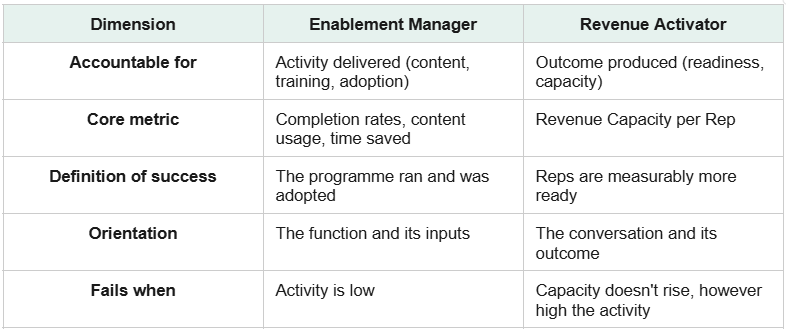
The last row is the whole point. An enablement manager can succeed on their own terms, high activity, high adoption, while the reps stay unready. A Revenue Activator cannot. If capacity doesn't move, the Activator has failed, no matter how much got shipped. Outcome ownership is a harder job. It's also the only one that's actually accountable for the thing the company is paying for.
How do you transition to a Revenue Activator-led org?
This is a re-charter, not a reorg. You're not necessarily hiring new people; you're redefining what the existing function is accountable for. Three moves:
- Re-charter the function. Shift the mandate from “run enablement” to “produce readiness.” State explicitly that the function exists to move capacity, and that activity is a means, not the end.
- Re-write the job spec. Change what the role is measured and rewarded on. If the job description still lists content shipped and training delivered as the deliverables, you've re-named the role without re-chartering it.
- Re-define the metrics. Replace activity metrics with capacity metrics as the primary scorecard. Completion rates can stay as diagnostics, but Revenue Capacity per Rep is what the function is now judged on.
The order matters: charter, then spec, then metrics. Change the metrics without changing the charter and you get a team optimising a new number with no authority to do the work that moves it. Change the charter first and the rest follows.
And frame it as what it is for the person in the seat: a promotion. The enablement manager who re-charters into a Revenue Activator isn't being demoted or displaced; they're moving from owning activity to owning outcome, from “the person who runs training” to “the person accountable for whether the revenue team can execute.” That's a bigger job, a more strategic seat, and a clearer path to the leadership table.
What signals tell you readiness is working?
Measure leading and lagging, and never confuse activity with either.
Leading signals (readiness is being produced):
- Capacity score is rising. Per-rep readiness, tracked as a number, trending up over time.
- Time-to-readiness is falling. New reps reach a productive, ready state faster than they used to, ramp compresses.
- Behavioural lift is observable. Reps demonstrably do the right things in conversations, visible in call reviews before it's visible in the numbers.
Lagging signals (readiness produced revenue):
- Capacity per rep converts to pipeline and won revenue without adding headcount; the same team produces more.
- Win-rate and ramp improvements trace back to readiness interventions, not just market conditions.
The anti-signal, same as ever: activity climbing while capacity stays flat. More content, more training, more adoption, and a readiness score that hasn't moved. That's the tell that you're still running an enablement function and measuring it as one, when what you needed was a Revenue Activator measuring the state.
Sales readiness was never the same as enablement. Readiness is the state your reps are in when they walk into the conversation. Enablement is one of the functions that's supposed to produce it. The teams that win the Agentic Era are the ones that stop measuring the function and start owning the state, and the role that owns it is the Revenue Activator.
The full operating model, the metric, the levers, and the identity shift behind it is in the Revenue Activation Manifesto. Start there if this reframes the job for you.
Frequently Asked Questions
What's the difference between sales readiness and sales enablement?
Readiness is a state, whether a rep is actually prepared to win their next conversation. Enablement is a function, the activities (content, training, tools, playbooks) meant to produce that state. They're often used as synonyms, but they can diverge: a busy enablement function can coexist with low readiness if the activity never changed behaviour. Readiness is the outcome; enablement is one input to it.
What is a Revenue Activator?
A Revenue Activator is the role that owns sales readiness as an outcome, accountable for the state of rep readiness and the revenue capacity it produces, not for the volume of enablement activity delivered. Defined by readiness produced, not training delivered. It's a re-charter of the enablement role around outcome ownership rather than activity ownership.
How is a Revenue Activator different from a head of enablement?
A head of enablement is typically accountable for running the function well, shipping content, running programmes, driving adoption. A Revenue Activator is accountable for the result those activities are meant to produce: ready reps and rising capacity per rep. The head of enablement can succeed on activity metrics while reps stay unready; the Revenue Activator cannot, if capacity doesn't move, the job isn't done.
Do you need a new hire, or can you re-charter?
Usually a re-charter, not a new hire. You're redefining what the existing function is accountable for: shift the mandate from “run enablement” to “produce readiness,” re-write the job spec around outcomes, and re-define the primary metric from activity to capacity. For the person in the seat it's a promotion, from owning activity to owning outcome, not a replacement.
What metrics does the Revenue Activator own?
Revenue Capacity per Rep is the primary metric, a per-rep measure of readiness tracked over time. Leading indicators include a rising capacity score, falling time-to-readiness, and observable behavioural lift in call reviews. Lagging indicators are capacity converting to pipeline and won revenue without added headcount, and win-rate or ramp improvements that trace to readiness work. Activity metrics (completion, adoption) survive only as diagnostics, never as the scorecard.


.avif)