

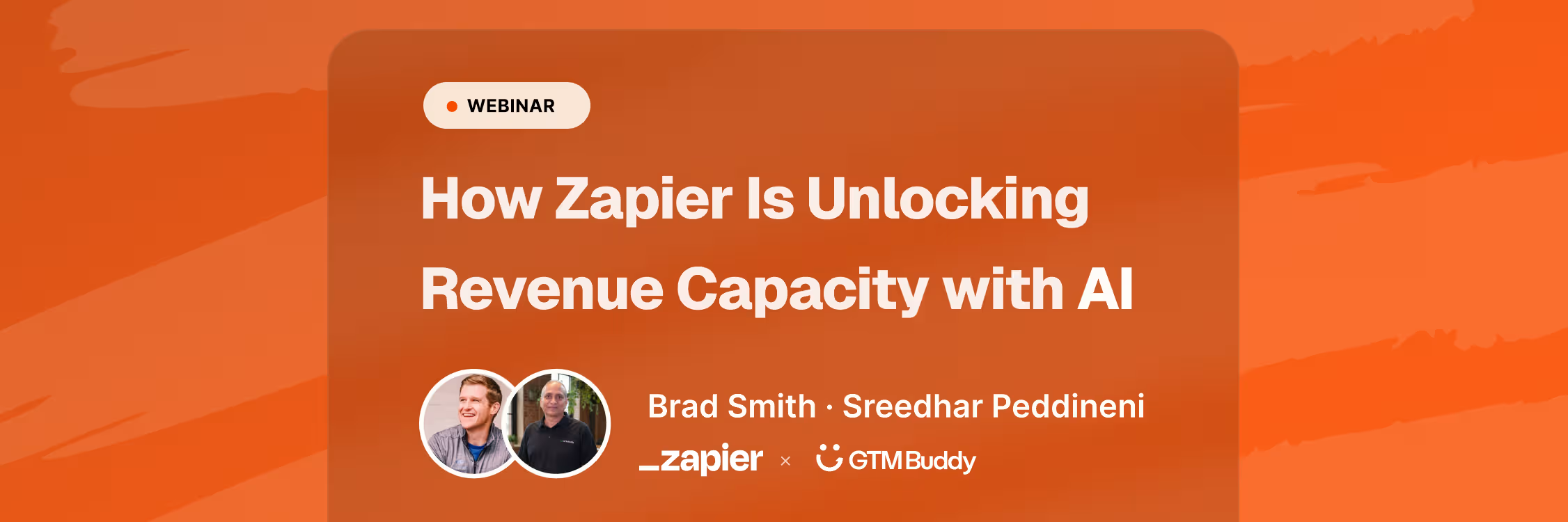
We recently hosted a fireside with Brad Smith, who leads startup and investor partnerships at Zapier. It was unscripted - no slides, no run-of-show, just Brad sharing his actual screen and walking through how he really works. At one point he ran a live portfolio analysis against a VC's website, hit a pagination limit in real time, and talked through it. That unpolished realness is exactly why what he showed matters: this wasn't a vendor demo. It was a practitioner showing his Tuesday.
And the throughline of the whole hour - the thing that kept surfacing whether we were talking about partnerships, MCP servers, or change management - was a single shift in what it now takes to do go-to-market work well.
The quarter Zapier replaced the hackathon with a “skillathon”
Brad described something Zapier did that stopped us: their quarterly hackathon became, one quarter, a skillathon. In his words: “now so many people like myself, I'm using Cursor on a daily basis… all of these are being built on skills and markdown files. I'd never created a markdown file until probably the last couple of months. We had a skillathon where everybody's building skills.”
Eight hundred employees, from the CEO to executive assistants, spending a week building skills - not features, not demos. Reusable units of agentic capability, written as markdown files, portable across tools.
The new skill we all need to learn is the art of creating good skills.
That line was Sree's response in the session, and it's the doctrine this whole piece rests on. Prompts still matter. But a prompt is something you type once. A skill is something you build once and run forever - a packaged, reusable unit of work an agent can load and execute. The shift from writing prompts to writing skills is the shift from operating an AI tool to building an agentic system. And it's barely six months old: the open standard for skills landed in December. Most go-to-market teams haven't registered that the literacy bar just moved.
The proof: a classic GTM problem, done in one prompt
Brad made it concrete with a task every partnerships and sales person will recognize. He needed to analyze a VC firm's portfolio before a meeting - which companies are already Zapier customers, what they're paying, where the white space is, who the power user is to anchor a webinar around.
The old way, as Sree named it in the session: “we used to go to that investor portfolio page, extract out the list, combine it with my data in the CRM… a very manual exercise with a lot of people.” Brad's version: a 13-step skill he built in Cursor that crawls the portfolio page, paginates through every company, checks each against Zapier's customer database, and returns who's a customer, what package they're on, and what AI tooling they use - from a single instruction.
That is the Agentic Era in one example. Not “AI wrote me an email.” An agent executing a multi-step research workflow that used to take a team an afternoon, triggered by one practitioner in natural language. The work around the conversation — the research, the matching, the prep ollapses. What's left for the human is the conversation itself: the meeting Brad walks into already knowing exactly where the opportunity is.
Brad's 3-layer cake and where revenue intelligence lives
Asked where this all goes, Brad offered his own framework, which he called the 3-layer cake:
- The prompt / UI layer: natural language as the new way we get work done. “I think we've walked through a one-way door of prompting.”
- The middleware layer: where connectivity and authentication live (where Zapier sits): “how do you make sure you're getting the right level of authentication at the right time to the right person?”
- The AI data layer: the unique, insightful data that AI generates for customers to act on.
What struck us is where Brad placed revenue intelligence. Unprompted, he said: “this is where GTM Buddy is really going to thrive too, because you're creating all those extreme level of insights and enablement… you're creating very unique data points with AI.” We didn't put that in his mouth it's where a practitioner mapping the future of the stack naturally placed the category. The intelligence layer is where the durable value accrues, because the prompt layer and the connectivity layer are commoditizing fast.
The honest part: human-in-the-loop, and the discipline of skills
The session didn't oversell. An audience question pushed hard if agents can now talk directly to APIs, why won't native AI orchestration just bypass middleware entirely? Brad didn't dodge it. He showed Zapier's own closed-beta agentic builder, then drew the line: the agent builds the automation, but a human still confirms the permissions, still catches the edge cases, still keeps the governance intact. “We can write AI with a human in the loop that's where we are right now.”
And his closing point is the one most teams will miss. After an agent does a piece of work, “say something like: this was great, I'll need to do this again in a month build a skill that keeps this reporting structure in place so I can do it quickly next time. That step gets missed by 99.9% of people.”
That's the literacy gap in a sentence. The people pulling ahead aren't just using agents they're capturing what works as reusable skills, compounding their capacity every week. The people falling behind are re-prompting from scratch every time, and re-doing the same work.
What this means for revenue teams
Brad's session was about partnerships, but the lesson generalizes to every revenue role. The capability that now separates a high performer from an average one is the ability to build and reuse skills to turn a piece of work you did once into a unit an agent runs forever. That's a new literacy, and like every literacy shift, the gap between those who have it and those who don't widens fast.
This is the heart of what we mean by Revenue Activation: AI owns the work around the conversation the research, the prep, the follow-up, the reporting so the human can own the conversation. Skills are how that division of labor actually gets built. A revenue team fluent in skills operates at a capacity a team without them simply can't match not because they work harder, but because they stopped re-doing work the agents should own.

.avif)

.png)